
 Crane Shock Absorber
POLARIS is a lightweight crane shock absorber for topside impact and overload: a pile that runs under its hammer, or the snap when a load is lifted off a supply vessel’s deck. A small gas volume and CFD-designed valves sit inside one hydraulic cylinder, with no external accumulators or needle valves, so the unit stays light and compact even at large capacities. In our 1,500 t pile-run study it cut the hook DAF from 2.28 to 1.43.
No external accumulators. No needle valves.
Conventional shock absorbers put the gas spring in large external accumulators and control the flow through a separate restriction, such as a needle valve. POLARIS keeps a small gas volume inside one hydraulic cylinder and controls the flow with CFD-designed valves. With fewer parts it is lighter, smaller and costs less for a comparable duty, and its energy-absorption efficiency is typically above 90 % in simulation.
- Preset with a small quantity of nitrogen, no external HPU
- Stays fully retracted under the static load until an event engages it
- Typically set up in under an hour; ready for reuse within an hour of an event, without being brought back to deck
The configuration starts with your lift case.
Each unit is configured for its event: the moving load, the speed it arrives at, the peak force allowed and the stroke available.
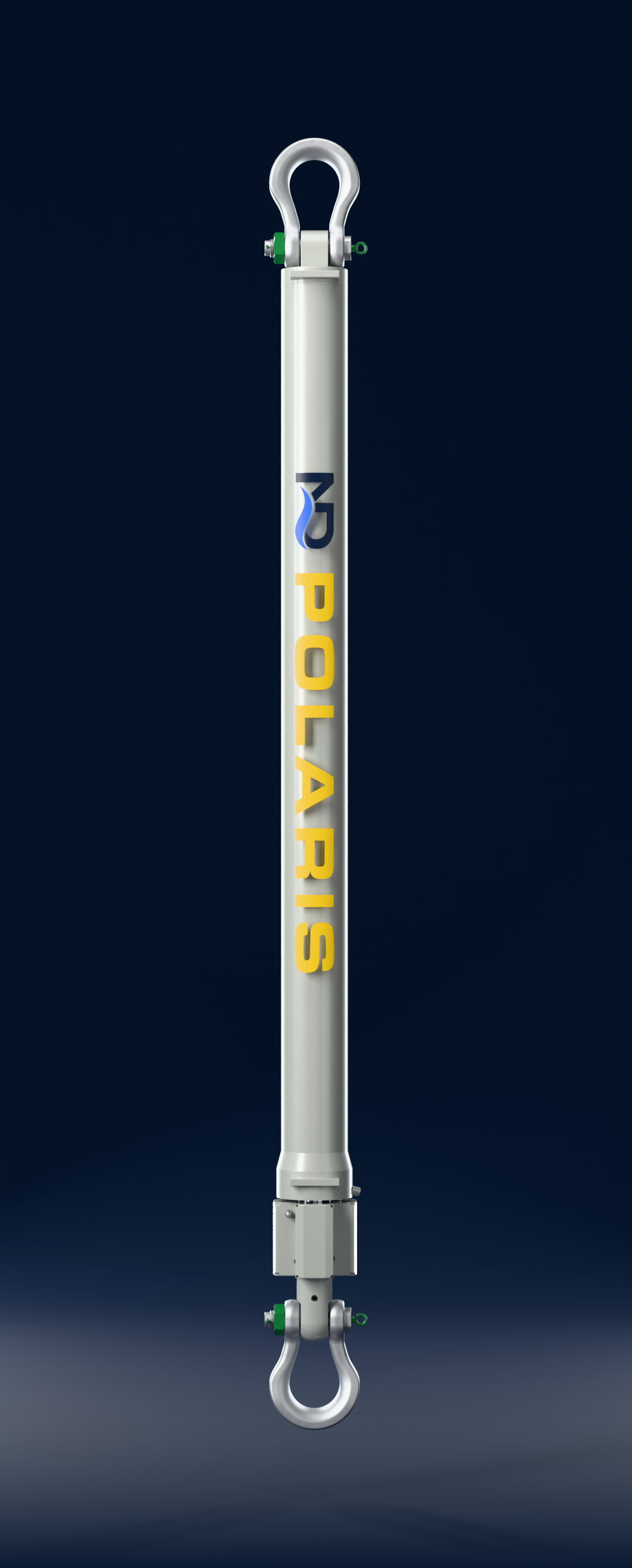 SWL 75–4,000 t · stroke 1.0–8.0 m
| Capacity and application | |
|---|---|
| Maximum force (SWL) | 75–4,000 tStandard steps: 75 · 150 · 250 · 400 · 600 · 800 · 1,000 · 1,250 · 1,550 · 2,000 · 2,500 · 3,000 · 3,500 · 4,000 t |
| Stroke length | 1.0–8.0 mStandard steps: 1.0 · 1.5 · 2.0 · 2.5 · 3.0 · 3.5 · 4.0 · 4.5 · 5.0 · 5.5 · 6.0 · 6.5 · 7.0 · 7.5 · 8.0 m |
| Application | Topside overload protection: falling-object loads such as a piling hammer, and snap loads when a load is lifted off the deck of a supply vessel |
| Architecture and energy absorption | |
| Architecture | Single hydraulic cylinder · internal gas spring · CFD-designed valves; no external accumulators or needle valves |
| Efficiency | Typically above 90 % in simulation: the energy absorbed over the stroke, divided by the peak force times the stroke used. The sizing factor η in our shock-absorption guide counts only the force above the static load, so it is lower. |
| Working principle | Gas spring ramps the force to the configured preset · valve controls force while the payload is brought to rest |
| Setup, rigging and monitoring | |
| Setup & reset | Typically set up in under an hour; ready for reuse within an hour of an event, without being brought back to deck |
| Adjustment | Preset with a small quantity of nitrogen · no external accumulators to fill or drain · no external HPU |
| Rigging | In line below the hook, with soft slings from the rod end to the load |
| Monitoring | Force, stroke and pressure measurement with data logging, as specified for the unit |
| Safety, verification and supply | |
| Safety | Piston-rod locking and fail-safe functions; pull tests in the agreed FAT scope |
| Verification basis | Designed and classed to DNV-ST-0378 |
| Budget price | Configurations from approximately USD 20,000 |
| Documentation | GA drawing · datasheet · calculation sheet · OrcaFlex model, on request through the form below |
What POLARIS does in a pile run
The same 1,500 t pile-and-hammer stack runs at 5.0 m/s twice, from one parameter set: once hanging on a rigid link, once on a 2,000 t POLARIS with 6.0 m of stroke.
One parameter set, two five-second runs: the same masses, stiffnesses, damping, gravity, initial state and integration step. With POLARIS, the 18,000 kN valve setting controls the arrest, the load below the unit peaks at about 19.3 MN (DAF 1.31), and the hook stays loaded throughout.
A modelled study, not a certified project analysis: each lift is checked against its own case and criteria. Read the pile-run arrest study →
One cylinder does it all
Gas spring ramps the force
POLARIS combines a hydraulic cylinder with an internal gas spring. When a falling load, such as a running pile, engages the unit, the gas spring ramps the force up until the damping preset is reached.
The valve controls the force
A CFD-designed valve controls the force while the payload is brought to rest, turning the event’s energy into heat over the stroke. In simulation its energy-absorption efficiency is typically above 90 %.
Ready for the next event
The unit stays fully retracted under the static load until an event engages it. Setup typically takes under an hour, and the unit is ready for reuse within an hour of an event without being brought back to deck. The preset uses a small quantity of nitrogen and no external HPU.
Light for its capacity
A 2,000 t unit with 6.0 m of stroke weighs about 28 t, rod included, so less of the crane chart goes to the absorber.
Testing and safety basis
Tested to DNV and project requirements for the configuration, with pull tests of the unit and its lifting points in the agreed FAT scope. Piston-rod locking, pressure monitoring and fail-safe functions are verified against the project’s safety basis.
Integrated architecture
For a comparable duty, fewer parts mean less material, less deck space and fewer servicing points.
Measured and logged
Force, stroke and pressure can be measured and logged through the event. Piston-rod locking and fail-safe functions protect the unit in handling and in operation.
POLARIS in the Knowledge Hub
Pile-run protection
Why piles run, what the punch-through does to the crane, and the modelled case.
Read → KB · SYSTEMSShock absorption
Peak-load reduction for falling-object and overload cases: the physics and the hardware.
Read → KB · FUNDAMENTALSDynamic amplification factor
What DAF means, how it is calculated, and what drives it in offshore lifts.
Read →Where POLARIS sits
 SWL 55–1,000 t
stroke 1.0–6.0 m 02
 SWL 12.5–10,000 t
stroke 1.0–6.0 m 03
 SWL 30–4,000 t
stroke 2.5–8.0 m 04
 SWL 75–4,000 t
stroke 1.0–8.0 mYou are here 07
 Lift screening
DNV-RP-N103 Compare all systems →
POLARIS, answered
What is POLARIS used for?
How does POLARIS work?
What are the benefits of POLARIS over accumulator-based shock absorbers?
- Everything sits in one hydraulic cylinder, with no external accumulators or needle valves: less weight, less deck space and a lower cost for a comparable duty.
- CFD-designed valves give a typical energy-absorption efficiency above 90 % in simulation.
- Setup typically takes under an hour, and the unit is ready for reuse within an hour of an event without being brought back to deck.
- The preset needs only a small quantity of nitrogen: no external accumulator to fill or drain, and no external HPU.
- The unit stays fully retracted under the static load until an event engages it.
When should I choose another solution instead of POLARIS?
Send your lift case.
Lead time and price depend on capacity, stroke and classification. Fill in the form and we’ll send drawings, a datasheet and a quotation for your case.
- GA drawing, sized to your duty
- Datasheet & calculation sheet
- OrcaFlex model of the unit
- A CONSTELLATION run of your event, with and without POLARIS