
Subsea Challenges
By Peter Wang, COO · November 2025
Practical application: For practical application of this topic, see engineering studies and analysis and custom hydraulics.
Subsea operations present unique engineering challenges that don’t exist in topside lifting. As equipment is lowered below the water surface, it encounters forces and conditions that significantly affect the lifting operation — including buoyancy changes, temperature variations, water pressure, and hydrodynamic effects.
Understanding these challenges is essential for planning safe and efficient subsea installations. Modern heave compensators are designed to account for these effects.
Buoyancy
Buoyancy is a force caused by the relative difference in mass density between air and seawater which causes the net weight of the lifted object to drop. The effect is relatively small if the object is massive steel, but can be really significant if it is either partially hollow or made from lightweight materials (such as concrete, plastic or aluminum). This can affect stability of the payload causing rotation. It also significantly affects compensation equipment, both in negative and positive ways:
- As the weight of the payload drops due to buoyancy it will cause the equilibrium position of the compensation cylinder to move inwards and in some cases cause the cylinder to fully retract. This will limit the performance of the compensator.
- If the compensator is adaptive it will drop the internal gas pressure so the equilibrium stays in the center. This is a positive effect for motion compensation efficiency as it will effectively increase the natural period of the compensator and reduce transmissibility.
Temperature
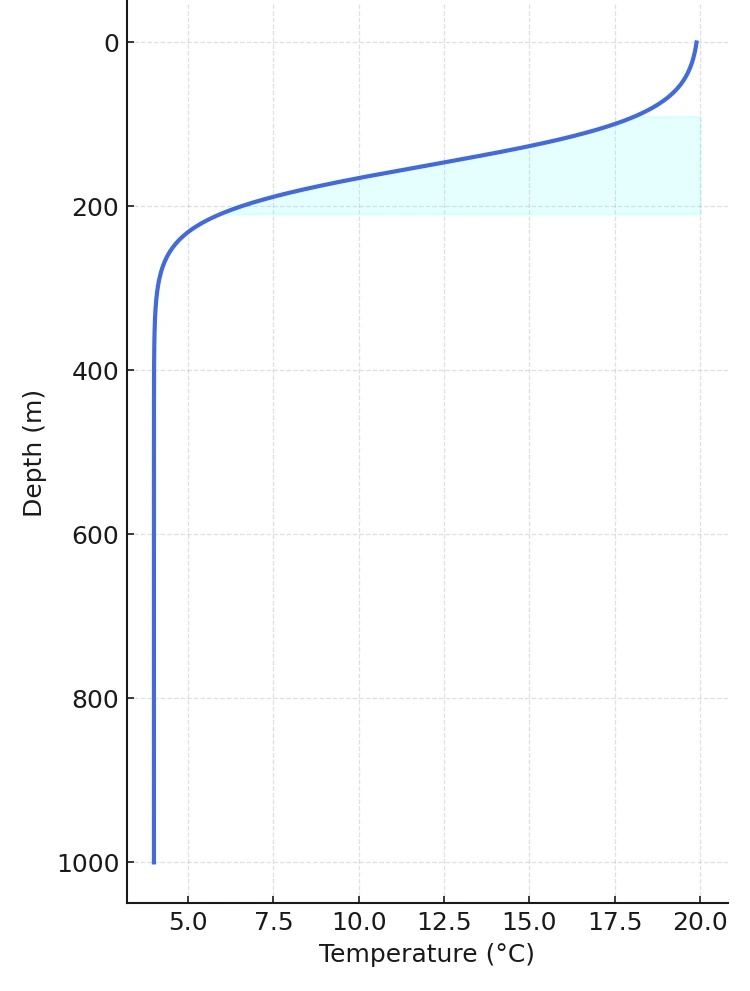
If the ambient temperature of the air is high compared to the seawater temperature or the surface water temperature is high compared to the water temperature at the landing depth then it will cause a significant drop in compensator gas pressure. As a rule of thumb we can say that the pressure drops 1 % per 3 °C of temperature drop, this corresponds roughly to 5% change in stroke (of overall stroke length and significantly depending on gas to oil ratio).
Typically the temperature follows a so called thermocline, an example is shown below, where the temperature rapidly drops in the beginning before it stops varying with depth.
Water pressure
Water pressure increases by about 1 bar for every 10 meters of water depth. This can have a significant effect on a compensators stroke equilibrium. As an example let us say we are lifting 250t (wet weight) with a 400t compensator from surface to 1000 m depth. The piston rod diameter can be assumed to be 180 mm. How much would the equilibrium position change?
We can assume that a 15% change in force will cause the rod to fully retract from mid stroke to zero stroke (typical value for relatively high stiffness PHC). At 1000 m the water pressure will be about 100 bar and the force that acts on the piston rod causing retraction will be:
26t is is about 10% of 250t, so in other words we can expect the stroke equilibrium to shift from the mid position (1/2 of full stroke) to about 1/6 of full stroke.
By using an adaptive PHC this problem can be avoided.
Leakage
In the past there has been many cases of water leakage into subsea compensators. The results have been everything from reduced performance, to corrosion to explosions. The problem can be avoided by proper design, testing and maintenance. At Norwegian Dynamics we have full focus on the problem and we believe we have the most robust solution to it in the market. We have implemented the following:
- Double seals on all volumes, where the seals always use two different surfaces to minimize seal damage during assembly.
- External pressure testing is part of FAT to verify seal integrity.
- Compartmentalization to mitigate consequences of a leak.
- Spare parts to quickly replace a damaged component.
- For mission critical applications we offer redundancy with multiple compartments capable of doing a single task.
- Back seal testing for critical compartments done as part of regular maintenance (and can be done offshore).
- Scheduled complete seal replacement.
Working on a lift that needs this?
Every subsea lift has its own envelope. Send the lift case and we'll come back with a compensator recommendation.