
 Wide-range passive heave compensator
A passive heave compensator with manually set damping and a self-centering spring, rigged in-line below the hook. It holds the payload in controlled tension through the water column and lands it softly on the seabed — no external power and no vessel active-heave system required.
Wide-range passive control
A self-centering spring returns the unit to mid-stroke as payload and geometry change through the lift, with damping set manually to the operation — so one unit covers a wide load and depth band.
- Self-centering spring — holds mid-stroke through the lift
- Passive — no external power required
- Compatible with AHC cranes
- Rigged in-line below the hook
- State-of-the-art laser-clad rod coating
- Per-unit DNV certificate at FAT
The configuration starts with your lift case.
Use the family ranges to define the duty, then confirm the selected configuration in the datasheet. Reference-build values are identified beside pressure, mass and end terminations.
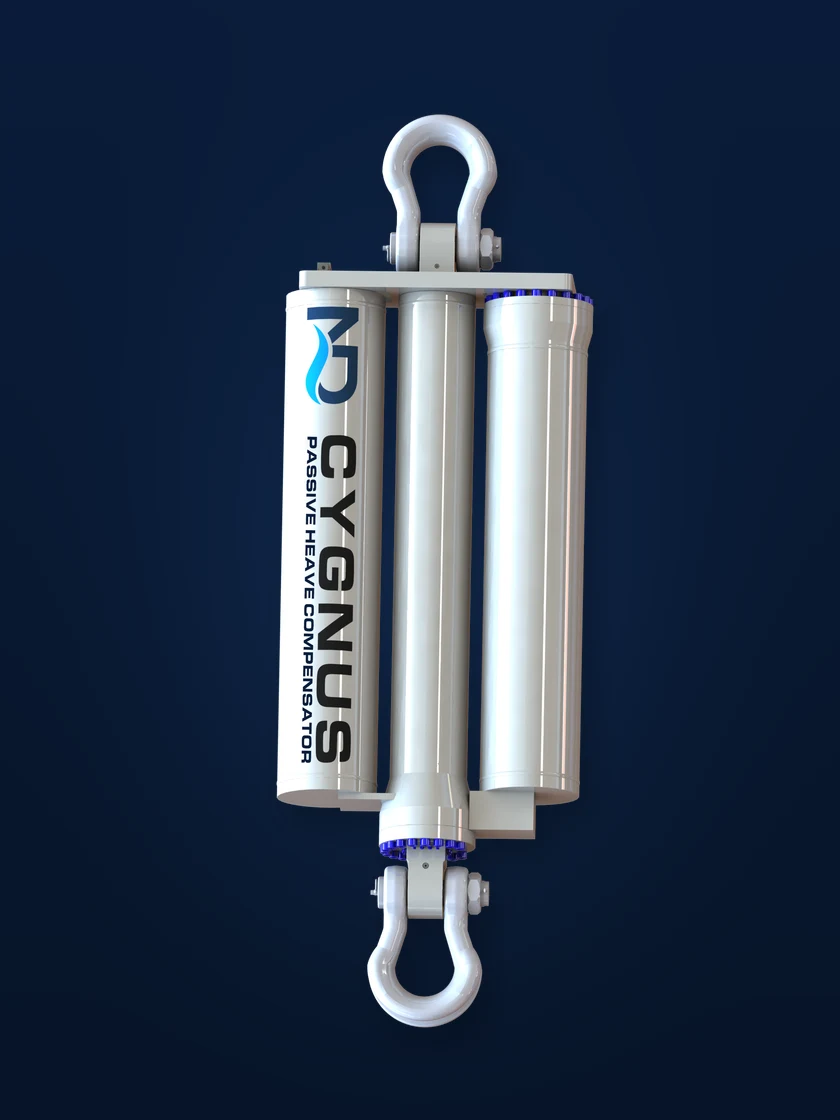 SWL 12.5–10,000 t · stroke 1.0–6.0 m
| Operation and working range | |
|---|---|
| Working principle | Passive heave compensation, gas-over-oil (N2), manual damping with automatic self-centering |
| Safe working load (SWL) | 12.5–10,000 tReference configuration on this page: 400 t |
| Stroke length | 1.0–6.0 mStandard range · long-stroke builds to 8.0 m, as in the storm-tethering film below |
| Depth rating | 3,000 m |
| Power | Battery (small) — no umbilical, no external power during the lift |
| Build details and reference values | |
| Design pressure | 350 bar (35 MPa)Reference 400 t / 3.0 m configuration |
| Mass in air | ~9.5 t (estimate)Reference 400 t / 3.0 m configuration |
| Tube / rod material | High-strength steel / stainless laser-clad rod coating |
| End terminations | 2 × 400 t certified bow shacklesReference configuration — sized to the unit SWL |
| Operating temperature | −20 to +50 °C |
| Certification and supply | |
| Standards | DNV-ST-0378 / -0194 · DNV-RP-N202 · ISO 9001 |
| Warranty | 18 months from approved FAT |
| Status | Available |
| Budget price | Configurations from approximately USD 15,000Entry point at low SWL — final pricing follows capacity, stroke and classification |
| Documentation | GA drawing · datasheet · calculation sheet · OrcaFlex model — on request via the form below |
Weights and dimensions are estimates, confirmed at detailed engineering. The full CYGNUS datasheet (EN / zh-CN) is available on request.
What CYGNUS does to a deepwater landing
A representative deepwater subsea landing at ~1,950 m, screened head-sea across the full sea-state range in CONSTELLATION — our in-house time-domain lift simulator. As the vessel heaves, the gas spring pays out and reels in against the load; the self-centering spring holds the unit at mid-stroke, so tension stays in the rigging through the water column and touch-down velocity stays controlled at set-down.
Screened across the full sea-state range, the workable window covers effectively the whole screened season at this site — the design point Hs 1.25 m / Tp 6.5 s passes with margin.
Modelled prediction screened to DNV-RP-N103 and the ND-DS basis — an engineering estimate, not a certified analysis. The operating window is confirmed against project metocean and the contracted vessel before each lift.
See CYGNUS in action
Three operations, same physics — every frame is rendered from the actual CONSTELLATION simulation, and the numbers on screen are the simulation’s own results.
Landing it is the easy part.
A 1,000 t nacelle assembly lands on a floating wind foundation at +157 m with a benign 0.18 m/s touch-down and impact factor 1.02. After contact, rigid rigging lifts off 30 times; CYGNUS keeps 672 t on the crane without going slack once.
Case: 1,000 t nacelle assembly · floating wind tower-top flange at +157 m · CYGNUS 1250 t passive heave compensator · foundation settlement ~0.40 m · touch-down 0.18 m/s · impact factor 1.02 · rigid lift-offs during bolt-up hold: 30 · with CYGNUS: 0 · preliminary regular-wave screening, 25 of 25 sea-state cells pass every screen.
Storm tethering — every wave, within SWL
A CYGNUS 1500 t unit in its long-stroke 8 m build holds a TLP tendon pretension line through a 30-minute Hs 4.0 m storm window — peak tendon tension 983 t, 53% of the tendon SWL, against 2,687 t (144%) on the bare line, with snap events cut from 43 to zero.
Case: TLP tendon pretension, 4 tendons, 200 m water · CYGNUS 1500 t / 8 m · Hs 4.0 m / Tp 12 s, 30-min window · peak tendon tension 983 t = 53% of tendon SWL (bare line: 2,687 t = 144%) · snap events 43 → 0 · peak stroke 7.30 m of 8.0 m.
Suction-anchor recovery — out of the mud, within SWL
A CYGNUS 700 t / 5 m unit recovers a Ø6 m suction caisson from firm clay in 120 m of water — peak line load 566 t, 87% of the 650 t crane’s safe working load, where a bare-wire baseline in the same sea reaches roughly twice the crane SWL.
Case: Ø6 m × 10 m suction caisson in firm clay · 120 m water · CYGNUS 700 t / 5 m passive heave compensator · 650 t crane, three-fall 90 mm hoist wire · Hs 2.5 m / Tp 8.0 s · peak line load 566 t = 87 % of the crane’s safe working load · payload ride ~3.7× smoother than a bare-wire baseline · one design-sea-state realisation.
Passive, by design
A gas spring carries the load
CYGNUS is a gas-over-oil (N2) unit rigged in-line below the hook. As the vessel heaves, the gas spring pays out and reels in against the load, so tension stays in the rigging through the water column.
Damping set manually to the lift
Damping is set manually to the operation before the lift — simple, robust field practice with no external power and no deck hydraulics during the lift. Monitoring runs on a small battery, with no umbilical.
Self-centering to mid-stroke
A self-centering spring returns the unit to mid-stroke as payload and geometry change through the lift, keeping stroke in reserve in both directions — and landing the load softly at set-down.
Classification
CYGNUS is designed, classed and tested to DNV-ST-0378 / -0194, with lifting to DNV-RP-N202 and a quality system to ISO 9001. A per-unit DNV certificate is issued at Factory Acceptance Test.
Committed to safety
We follow and exceed the testing requirements in DNV-RP-N202. Every unit is hydrostatically pressure tested and overload tested to 1.1 × SWL plus self-weight, with a full function test before a per-unit DNV certificate is issued at FAT. The engineers who design the unit review every test and deviation.
Sustainability
CYGNUS runs entirely on stored gas pressure — no external power and no deck hydraulics during the lift, cutting energy use and emissions offshore. Compatible with biodegradable fluids for sensitive areas.
Engineered for heavy subsea work
Manually set damping and a self-centering spring — simple, robust field practice for heavy deepwater lifts.
CYGNUS’s lane in the Knowledge Hub
Passive heave compensation
How a gas spring holds a load through vessel heave — the physics and the hardware.
Read → KB · OPERATIONSSubsea lifts
Splash zone to touch-down — what drives the operating window on a subsea lift.
Read → KB · SELECTIONHeave compensator selection
RIGEL, CYGNUS, ANTARES or VEGA — a practical selector for your lift case.
Read →Where CYGNUS sits
 SWL 55–1,000 t
stroke 1.0–6.0 m 02
SWL 12.5–10,000 tstroke 1.0–6.0 mYou are here 03
 SWL 30–4,000 t
stroke 2.5–8.0 m 07
 Lift screening
DNV-RP-N103 Compare all systems →
CYGNUS, answered
What lifts is CYGNUS built for?
How does CYGNUS work?
CYGNUS or RIGEL?
How is a CYGNUS unit sized?
Built, tested and handed over in six weeks
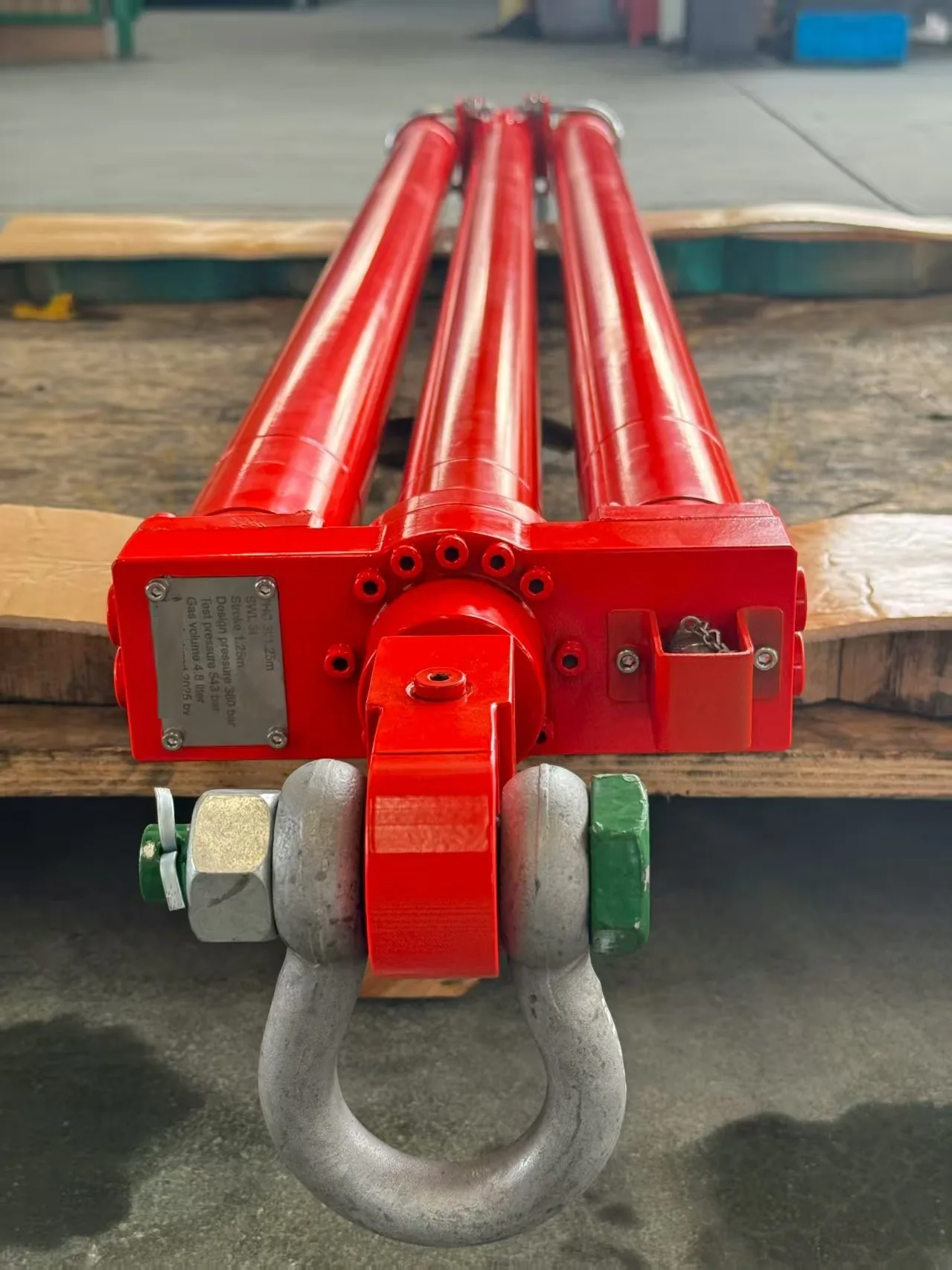
A three-cylinder passive heave compensator, built to a customer’s duty and delivered to the UK — six weeks from order to handover. A one-off build below the standard range, photographed at final inspection.
| Safe working load | 3 t |
|---|---|
| Stroke | 1.25 m |
| Design pressure | 360 bar |
| Test pressure | 543 bar |
Send your lift case.
Pricing follows capacity, stroke and classification — send the SWL, stroke, sea state, water depth and operation sequence, and we’ll screen the case in CONSTELLATION and return a sized configuration with drawings, datasheet and a project-specific quotation.
- GA drawing — sized to your duty
- Datasheet & calculation sheet
- OrcaFlex model of the unit
- CONSTELLATION screening across your sea states