DNV-RP-N103: Modelling and Analysis of Marine Operations
DNV’s recommended practice for calculating the loads on marine operations, and the successor to DNV-RP-H103. What it covers, how its simplified method handles a lift through the splash zone, and where its results feed into heave compensator sizing.
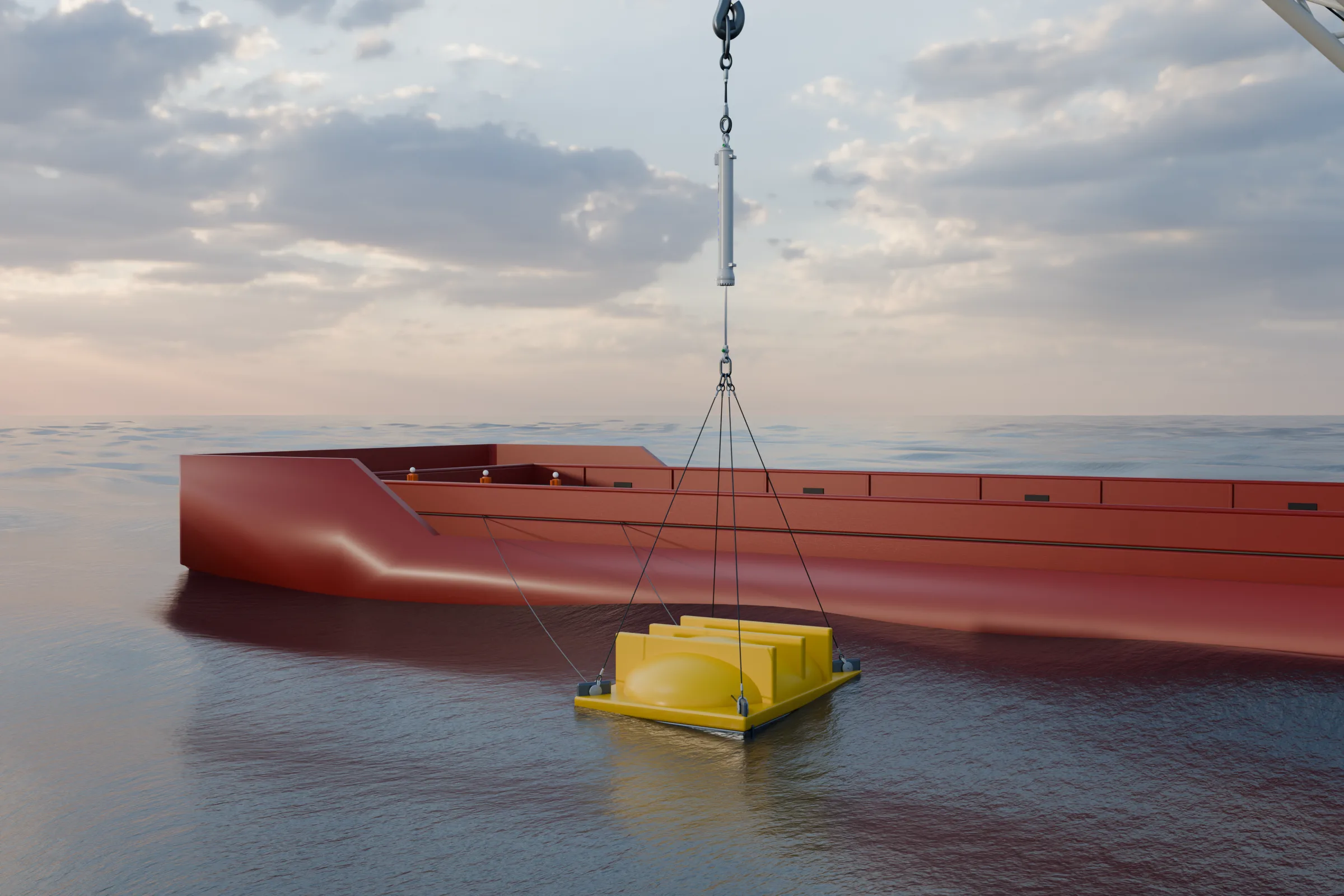
- DNV-RP-N103 is DNV’s recommended practice for modelling and analysis of marine operations. Its stated objective is to give simplified formulations for the design loads used to plan and carry out marine operations.
- It replaced DNV-RP-H103, last issued in February 2014, in July 2017 (as DNVGL-RP-N103). The current edition is 2017-07, amended 2021-09.
- For a lift through the splash zone, its simplified method combines slamming, drag, the mass force and the varying buoyancy into one hydrodynamic force, and checks it against 90 % of the object’s minimum static weight in water: F_{\text{hyd}} \le 0.9\, F_{\text{static,min}}, or the slings can go slack.
- Where slack slings cannot be ruled out, it gives the snap load, F_{\text{snap}} = v_{\text{snap}} \sqrt{K (M + A_{33})}. A heave compensator enters the method as a soft spring that lowers it, with a check on its stroke and on resonance.
Every subsea lift has to answer the same questions before it leaves the deck: how big the loads get as the object passes through the waves, whether the slings stay in tension, and what the crane and rigging must be rated for. DNV-RP-N103 gives the methods to answer them. It is a recommended practice: it applies where the project basis nominates it, usually alongside DNV-ST-N001, the standard for marine operations and marine warranty.
What DNV-RP-N103 is
DNV publishes the recommended practice (RP) under the title Modelling and analysis of marine operations. It started as DNV-RP-H103, first issued in April 2009 and last issued in February 2014, and was replaced in July 2017 by DNVGL-RP-N103. That revision changed the document code, the company name and the references. With DNV’s change of name in 2021 it became DNV-RP-N103, amended in September 2021. Searches and older lift plans still cite RP-H103, and the methods on this page appear in both.
| Designation | Editions | Status |
|---|---|---|
| DNV-RP-H103 | 2009-04, 2010-04, 2011-04, 2014-02 | Replaced by DNVGL-RP-N103 |
| DNVGL-RP-N103 | 2017-07 | Renamed in 2021 |
| DNV-RP-N103 | 2017-07, amended 2021-09 | Current |
DNV lists the current edition on its RP-N103 page. The full text is in DNV’s Rules and Standards Explorer, which needs a free Veracity login and a paid Explorer+ subscription; the table of contents and first section are free to view, and DNV offers a one-time 14-day trial. The older DNV-RP-H103 editions are free PDFs in DNV’s archive of legacy documents, useful for background; a project uses the edition its basis nominates.
What it covers
The RP’s main sections, numbered as in the document (Section 1 is the introduction):
- General methods of analysis. Waves and wave spectra, and wave loads on large and small structures.
- Lifting through the wave zone, general. The loads on an object passing through the surface, hydrodynamic coefficients, the calculation methods, lifts through a moonpool, and stability.
- Lifting through the wave zone, simplified method. Static weight, the hydrodynamic forces, the slack-sling criterion, capacity checks and snap loads. This is the part most splash-zone lift checks start from.
- Deepwater lowering. Cable forces, natural periods and resonance of the lowering system, slack cable, heave compensation and fibre ropes.
- Landing on the seabed and retrieval. Landing impact, skirt penetration, installation by suction and levelling, and retrieval of foundations.
- Towing. Surface and submerged tows.
- Weather criteria and availability. Forecast uncertainty, operability and persistence statistics.
- Lifting operations. Light and heavy lifts, crane-tip motion, coupling between vessels, and lift-off from a barge.
Appendices give added-mass and drag coefficients for common shapes and physical constants. Most of those drag coefficients are for steady flow. In the wave zone the RP uses the oscillatory-flow value, typically two to three times higher, and without CFD or model tests it gives C_D \ge 2.5 for typical subsea structures. Our subsea lifts article shows how drag and added mass scale with shape and speed.
The simplified method for splash-zone lifts
Section 4 gives a first, conservative estimate for an object lowered through the wave zone, using a few characteristic values instead of a full simulation. It assumes that the object is small compared with the wavelength, that it follows the crane tip with no resonance amplification, and that the vertical motion between the object and the water dominates. The section numbers below are those of the RP.
Static weight (4.2). The weight in water, from the mass in air and the displaced volume:
It is taken with a minimum and a maximum where the object floods after it submerges. The slack-sling check uses the minimum; the capacity check uses the maximum.
Wave periods (4.3.2). Where the wave period is taken into account, the analysis covers zero-up-crossing periods across
for a design significant wave height H_s. The RP’s alternative, wave kinematics independent of the period, holds only for T_z \ge 10.6 \sqrt{H_s / g}; an analysis uses one or the other.
Relative velocity. The hook lowering speed v_c, typically 0.5 m/s, adds to the combined crane-tip velocity v_{ct} and water particle velocity v_w, which the method takes as independent:
Force components (4.3.5 to 4.3.8). Four forces act as the object crosses the surface (Figure 1): slamming on the parts that hit the water, growing with the impact velocity squared; drag, with the relative velocity squared; the mass force, which combines the object’s mass plus added mass accelerated with the crane tip, (M + A_{33})\, a_{ct}, with the displaced water mass plus added mass accelerated by the waves, (\rho V + A_{33})\, a_w; and the varying buoyancy, \rho g\, \delta V, as the water surface moves up and down relative to the object.
Slamming and drag act in phase, and the mass force and the varying buoyancy act 180° out of phase, so the method combines them as (4.3.9)
and the characteristic total force on the object is (4.4.2)
A long object such as a spool, whose loads differ from sling to sling, needs a more refined analysis than this.
Slack slings and snap loads
If the hydrodynamic force lifts the object harder than its own weight pulls down, the slings go slack, and they snap taut again a moment later. The simplified method avoids that with the slack-sling criterion (4.4.3):
That is a 10 % margin to the start of slack slings, checked with the minimum static weight and the upward hydrodynamic forces. The weather criteria for the lift are set so that it holds.
Where snap loads cannot be avoided, the RP gives their size (4.7) from the snap velocity, the stiffness K of the hoisting system and the object’s mass with its heave added mass:
The total force is then F_{\text{static}} + F_{\text{snap}}. The same formula covers the snap at lift-off from a moving deck.
For the capacity check (4.4.4), the RP takes the larger total force with the maximum static weight, F_{\text{static,max}} + F_{\text{hyd}} or F_{\text{static,max}} + F_{\text{snap}}, and converts it to a factor on the weight in air for the lifting standard:
Our dynamic amplification factor article works through the snap load and the DAF in more detail.
Where a heave compensator enters
A heave compensator enters the simplified method in one place: as a soft spring in the hoisting stiffness K (4.3.3.4). That lowers the snap load. The softer stiffness also lengthens the natural period of the hoisting system,
where m L is the mass of the hoisting line and \theta a factor for its effect, so the RP includes the compensator the same way when it checks the risk of resonance. Resonance amplification itself is outside the simplified method, and the method does not credit the compensator with reducing the motion that reaches the object; both take a time-domain analysis.
The RP also sets a limit (4.7.7): a passive compensator must not run out of stroke, because running out can cause very large peak loads and failure of the hoisting system. The available stroke is checked in each load case, around an equilibrium that shifts as the static weight changes from air to water, allowing for entrapped water on recovery and, where relevant, water pressure on the piston.
Beyond the simplified method
When the simplified method shows a risk of snap loads, the object is large compared with the waves, or the lift is near resonance, the RP points to more accurate methods (Section 3): a regular design wave approach, time-domain analysis in irregular waves, and CFD for the local flow. A time-domain model follows the whole lift, including the wire, the rigging and any compensator, and reports the tensions, motions and stroke as time series. That is where a compensator’s reduction of the object’s motion is credited, and what CONSTELLATION does.
How RP-N103 feeds compensator sizing
The analysis gives the loads and motions; the compensator is sized from them:
| The analysis gives | It sets the compensator’s |
|---|---|
| Relative motion to take up, and the shifts in equilibrium: from air to water, on recovery with entrapped water, and with depth for a pressurised piston | Stroke |
| Wave periods of the operation, against the natural period of the lift | Stiffness, through its gas volume |
| Response near the natural period of the lift, where damping limits the amplification | Damping |
| Peak combined load, static plus hydrodynamic or snap | Capacity |
The RP itself models a passive compensator in Section 5.4, as a spring and damper at the crane tip above the wire, and rates it by its efficiency, e = 1 - |G(\omega)|, where G(\omega) is the ratio of the object’s motion to the motion at the top of the compensator. DNV-RP-N202, DNV’s recommended practice for heave compensating systems (edition 2024-06), covers the compensator itself, where the project nominates it. Our passive heave compensation article shows how stroke and gas volume set the response.
Sources and assumptions
- The formulas and criteria on this page are from the simplified method for lifting through the wave zone (Section 4) and the heave-compensation model (Section 5.4) of DNV-RP-H103, April 2010. Section numbers in parentheses are from that edition.
- DNVGL-RP-N103 (July 2017) states that it supersedes the February 2014 edition of DNV-RP-H103. That revision changed the document code, the company name and the references, and kept the section structure. RP-H103 was issued in April 2009, April 2010, April 2011 and February 2014.
- Edition data from DNV’s listing of DNV-RP-N103: edition 2017-07, amended 2021-09. Access terms from DNV’s Explorer+ FAQ.
- This page explains the method; a project analysis uses its own coefficients, sea states and acceptance criteria.
Frequently asked questions
What is DNV-RP-N103?
DNV’s recommended practice Modelling and analysis of marine operations. It gives simplified formulations for the design loads used to plan and carry out marine operations: lifts through the splash zone, deepwater lowering, landing on the seabed, towing and weather criteria. The current edition is 2017-07, amended 2021-09.
What is the difference between DNV-RP-H103 and DNV-RP-N103?
DNV-RP-N103 is the successor. DNV-RP-H103, issued from 2009 to 2014 (last edition February 2014), was replaced in July 2017 by DNVGL-RP-N103, which became DNV-RP-N103 when DNV changed its name in 2021. The 2017 revision changed the document code, the company name and the references; the simplified method for lifting through the wave zone carried over, in the same section structure.
Is DNV-RP-N103 available as a PDF?
Not free. DNV-RP-N103 is in DNV’s Rules and Standards Explorer, which needs a free Veracity login and a paid Explorer+ subscription; the table of contents and first section are free to view, and DNV offers a one-time 14-day trial. The older DNV-RP-H103 editions are free PDFs in DNV’s archive of legacy documents, useful for background; a project uses the edition its basis nominates.
What is the slack-sling criterion in DNV-RP-N103?
In the simplified method, the hydrodynamic force must stay at or below 90 % of the object’s minimum static weight: F_{\text{hyd}} \le 0.9\, F_{\text{static,min}}. The 10 % margin keeps the slings from going slack, and the weather criteria for the lift are set so that it holds.
How does DNV-RP-N103 calculate snap loads?
From the snap velocity, the stiffness of the hoisting system and the object’s mass with its heave added mass: F_{\text{snap}} = v_{\text{snap}} \sqrt{K (M + A_{33})}. The total force is the static weight plus the snap load. For the capacity check it is taken with the maximum static weight and converted to a factor on the weight in air, \text{DAF}_{\text{conv}} = F_{\text{total}} / (M g).
How does DNV-RP-N103 relate to DNV-ST-N001?
DNV-ST-N001 sets the requirements for marine operations and marine warranty; DNV-RP-N103 gives the methods to calculate the loads and responses those requirements are checked against. DNV-RP-N202 covers heave compensating systems themselves.
Does a heave compensator remove snap loads?
It lowers them. In the simplified method a passive compensator counts only as a soft spring in the hoisting stiffness, which lowers the snap load; the softer stiffness also lengthens the natural period, so the lift is checked for resonance. The compensator must not run out of stroke, and its equilibrium moves as the object goes from air to water, so the stroke is checked for each load case. A time-domain analysis credits the reduced motion of the object and checks the tension and stroke through the whole lift.
Running the RP-N103 numbers on a real lift?
Send the object’s geometry and weight, the operation sequence, the vessel data and the sea states. We’ll set up the analysis, run it with and without a heave compensator in CONSTELLATION, and give you the loads, slack-sling margins and the compensator it needs.
Send your lift case →Free download · 8 pages
Offshore Lift Load Cases: ND benchmark figures
What a lift actually measures, with and without passive compensation, from Norwegian Dynamics' own time-domain simulations. It reproduces no standard: the value is the figures, which no standard publishes.