
Dynamic Amplification Factor (DAF)
A peak load needs a reference.
DAF is the peak of a named load response divided by its matching static or quasi-static reference. State where it is measured, what it is compared with, and which lift phase it describes.
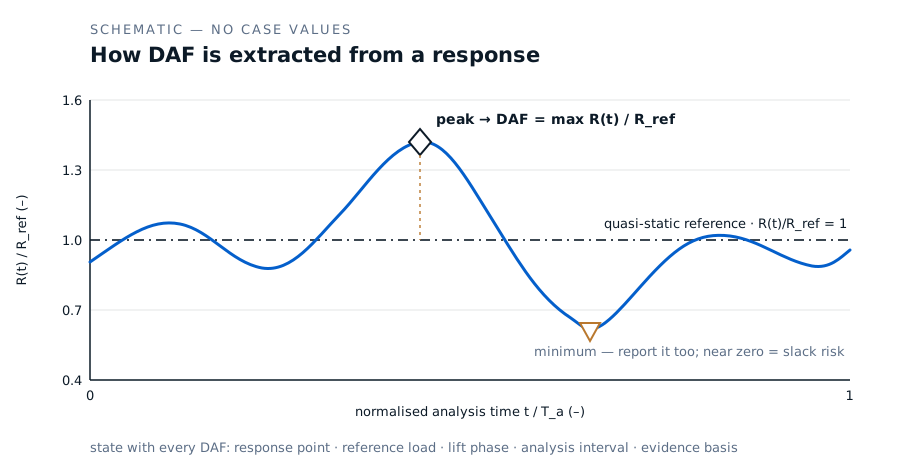
One trace. Three things to report.
The peak gives the DAF. The reference gives it meaning. Minimum tension needs its own check.
Peak response
Divide the maximum response by the matching reference to obtain the DAF.
Reference load
Name the load channel and reference. Hook load and sling-group tension describe different locations.
Minimum tension
Report it separately. A peak ratio alone does not establish whether the line stayed taut.
Which analysis does your lift need?
Choose the lift phase you are assessing. You will get either a study route or, for one narrow taut-line case, an illustrative harmonic screen. No output here is lift engineering.
Lift-off or transfer between moving bodiesStudy route
No number from this screen.
Lift-off is governed by the relative motion of two bodies, the velocity at the moment of engagement, and contact: none of which a single-body harmonic model represents.
The analysis has to represent
- relative motion of the two bodies, including phase
- relative velocity at engagement
- clearance, contact and load transfer off the supporting body
- hoist speed and preload
What to prepare for a study
- both vessels or the vessel and the fixed structure, with their motion basis
- the lift-off sequence and hoist speed
- object mass, centre of gravity and lift points
- rigging arrangement and hoist-wire properties
Clear of deck and water: line continuously tautIllustrative screen
An illustrative harmonic screen is available for this phase.
It applies only while the load is clear of deck and water and the line stays taut throughout. It is not a design-basis DAF, a crane-capacity check, an allowable sea state, or equipment selection.
What you need to hand
- Crane-tip vertical amplitude Atip (m) or acceleration atip (m/s²), and where it came from
- The excitation period T: the imposed response period, not wave Tp
- For the amplified result: a known Tn, or meff and Keff to derive it
- A damping ratio ξ. There is no default: near resonance it largely sets the answer
- Optional: static hook tension W0 (kN), to get forces rather than factors
Only have Hs and Tp? Sea state alone does not define crane-tip motion: vessel response, heading, loading condition and crane position are all needed. This screen will not guess it for you.
Open the illustrative taut-line harmonic screen
Illustrative only. Not lift engineering, and not a substitute for analysis.
Add hoist and load dynamics optional
Without this the screen reports only the rigid crane-tip term. With it, it adds the amplification the suspended system contributes near resonance.
View response curve and loss-of-tension threshold
Calculation note: copy or print
Splash-zone entry or exitStudy route
No number from this screen.
Water entry is governed by buoyancy through the surface, added mass, drag and slamming, plus the wave kinematics at the object. Those forces are simply absent from this model.
The analysis has to represent
- displaced volume against immersion depth
- the buoyancy transition through the free surface
- added mass and drag
- slamming, and the wave kinematics at the object
- lowering speed through the zone
What to prepare for a study
- object geometry and the hydrodynamic basis for it
- dry mass, centre of gravity and submerged weight
- lowering speed and the intended crossing window
- sea state and the vessel motion basis at the lifting point
Submerged lowering or landingStudy route
No number from this screen.
Submerged lowering and landing are governed by buoyancy, added mass, drag, wire dynamics and touchdown contact. Both the static reference and the effective inertia change as the object goes down.
The analysis has to represent
- submerged weight and buoyancy
- added mass and drag at depth
- wire and rigging dynamics over the full payout
- touchdown and contact at the seabed or structure
What to prepare for a study
- water depth and the lowering profile
- object geometry, mass and hydrodynamic data
- wire payout, stiffness and rigging arrangement
- landing target and its acceptance criteria
Pile run, shock or possible slackStudy route
No number from this screen.
A pile run or snap is a transient, tension-only event: the line goes slack and re-tensions. A steady-state linear model cannot represent it: it is precisely the case this model is invalid for.
The analysis has to represent
- the run-out or lowering velocity
- the engagement and re-tension condition
- tension-only line behaviour through slack
- the force–stroke behaviour of any shock absorber, including end stops
What to prepare for a study
- pile or object mass and the run-out velocity
- the hoist arrangement and its stiffness
- the allowable peak load at the crane tip
- the operation sequence around the event
Model boundaries: what this screen cannot calculate
- Crane-tip motion from a sea state: that needs vessel response at the lifting point
- Irregular-wave statistics, operation duration, or an Hs × Tp operating window
- Water entry: buoyancy, added mass, drag and slamming
- Lift-off, set-down, contact, and two independently moving bodies
- Slack, re-tension and snap: these are transient and non-linear
- Winch and control-system behaviour, compensator stroke and end stops
- Distributed wire and crane modes: this is a single vertical mode
Mechanisms, calculations and project evidence.
Continue with the full guide, or jump to the matched case studies.
In real crane lifts, DAF is driven by relative motion through the whole load path. The crane tip, hook, wire, slings and payload do not move as one rigid body: relative acceleration changes tension, compliance stores and releases energy, hydrodynamic forces alter the effective load, and loss and recovery of tension creates a nonlinear snap event. A descending boom tip does not itself prove slack: slack occurs only when computed tension reaches zero.
Supply-vessel deck lift. A cargo container on a supply vessel follows the vessel heave and roll, while the crane tip follows the crane vessel or platform. If the hook is moving up as the deck or container is moving down, the sling can go from slack or low tension to fully loaded in a fraction of a second. This snap load can be much higher than the static container weight.
Splash-zone crossing. During a splash-zone crossing, buoyancy, drag, added mass and wave particle velocity change quickly as the payload passes through the free surface. The hook load can rise and fall rapidly, especially when the crane, wire and payload dynamics line up with the wave period.
Other common triggers include sudden lift-off from deck, landing impact, snagging, fast crane motion, emergency stops and resonance in the crane-wire-payload system.
Snap loads: slack and re-tensioning
The most violent DAF events are snap loads: the sling goes slack, then re-tensions suddenly. While the wire is slack the hook and payload move independently, and when it comes taut the velocity difference has to be absorbed by wire stretch almost instantly. For an idealised, undamped single-mode screen, payload of mass m (plus added mass mA if submerged) on a load path of combined tangent stiffness k, the velocity-driven tension increment above the quasi-static load is approximately
F snap equals v rel multiplied by the square root of k multiplied by the quantity m plus m sub A.where vrel is the relative velocity at the moment the wire re-tensions. This is not the total peak snap tension: k is the combined tangent stiffness of the whole load path, the mass term is an equivalent participating mass, not automatically payload plus added mass, and once a line can lose tension, peak and minimum tensions belong to nonlinear, tension-only transient analysis. Within the screen the increment scales with the square root of stiffness, doubling k raises it by about 41% for the same velocity mismatch, but added compliance also increases travel and shifts the natural period, so it is not automatically safer: available stroke and end-stop loads must be checked. DNV-RP-N103 sets out when snap loads must be assessed and how the peak is calculated. Keeping the line under tension through the wave cycle prevents the slack-to-taut transition in the first place: a passive heave compensator can do this within its analysed motion and force–stroke envelope, but that envelope has to be demonstrated, not assumed.

How to reduce DAF
- Shock absorbers for snap loads. A POLARIS crane shock absorber adds stroke and damping between the crane and payload. It absorbs the kinetic energy of a single shock event (deck lift-off, a snap load, an overload) before it becomes peak crane load, provided its force–stroke behaviour, available travel and end-stop loads suit the event. It needs time to reset afterwards, so for repeated slack–snap cycles in the wave zone, use heave compensation instead.
- Passive heave compensation for splash-zone crossings. A passive heave compensator reduces relative motion between the crane hook and subsea payload. This keeps rigging tension smoother through the splash zone and reduces the dynamic amplification the crane sees: within the unit’s analysed load, frequency and stroke envelope.
- Control the lift as well as the equipment. Lower crane speed, avoid resonant sea states, plan weather windows and use soft lift-off procedures. The equipment reduces DAF, but the operation still sets the starting conditions.
Product routing follows the governing mechanism: the scenario section below shows which. For crane-side demand, compare the crane load chart.
A first screening estimate for a dry lift, clear of deck and water on a continuously taut line, with the payload following a prescribed sinusoidal crane-tip motion, is
where aheave is the maximum vertical acceleration at the crane tip and g is gravitational acceleration (9.81 m/s²). For sinusoidal crane-tip motion with single amplitude ζ (the vertical motion at the lifting point, not Hs) and response period T, which is not automatically the wave-spectrum peak period Tp:
For example, with a 1.5 m heave amplitude and an 8 s period:
This is the rigid crane-tip screen only. The coupled hook response can be higher near a system natural period or lower in the isolation region: it depends on the frequency ratio, damping, stiffness, line length, payload mass and hydrodynamics. Legacy DNV-OS-H205 lifting provisions were consolidated into DNV-ST-N001; the project-nominated edition and its factors govern.
More accurate DAF calculations model the vessel, crane, hoist wire, rigging and payload hydrodynamics as one coupled system. Commercial time-domain tools such as OrcaFlex, and ND’s own CONSTELLATION, are used for this; for the water-entry physics, see the splash-zone crossing guide.
Why there is no transferable DAF range
A standard minimum factor, a project-calculated response and a result from one simulation are different kinds of number. Every value needs its load channel, reference load, lift phase and evidence basis.
| Lift scenario | Uncompensated | With the stated mitigation | Basis |
|---|---|---|---|
| Splash-zone lift, 35 t (ND study) | DAF 3.41 to 5.38 | 1.15 to 1.91 with RIGEL | Coupled time-domain simulation, 8 wave realisations |
| Pile-run arrest (ND study) | 2.28 with a rigid link | 1.43 with POLARIS | Coupled arrest simulation, study CS-2026-005 |
| Snap at lift-off, illustrative | 3.2× | 1.28× with a shock absorber | Single 1-DOF simulation (Figure 1); not an upper bound |
| Any other lift | Calculate it | Calculate it | Phase-specific analysis on the project basis; DNV-ST-N001 sets minimum in-air values by hook load |
DAF by lift scenario: without compensation, with the stated mitigation, and the basis of each number.
Minimum tension is a separate acceptance check, not part of the DAF definition. Any preliminary no-slack or percentage threshold shown in an ND screen is an ND screening default unless the project basis identifies an applicable requirement and clause.
Which DNV document does what
- DNV-ST-N001: the marine-operation load cases, planning and the marine-warranty basis.
- DNV-RP-N103: modelling guidance and simplified formulations for marine-operation design loads.
- DNV-RP-N202: heave-compensator design parameters, performance and validation.
- DNV-ST-0378: lifting-appliance design and certification; it does not set the project DAF or approve a lift operation.
The contract- and MWS-nominated editions, project assumptions and acceptance criteria govern. Equipment certification and operation-specific lift approval are separate matters.
What a defensible before/after comparison contains
What a commissioned study returns instead
Two separate commissioned CONSTELLATION cases, shown because they cover physics the screen above deliberately excludes. Each is a matched pair (the same lift run with and without ND equipment in the load path, from one set of inputs) and each carries its full engineering basis. They are not generated from your inputs, are not a validation of the screen, and are not transferable to another lift.
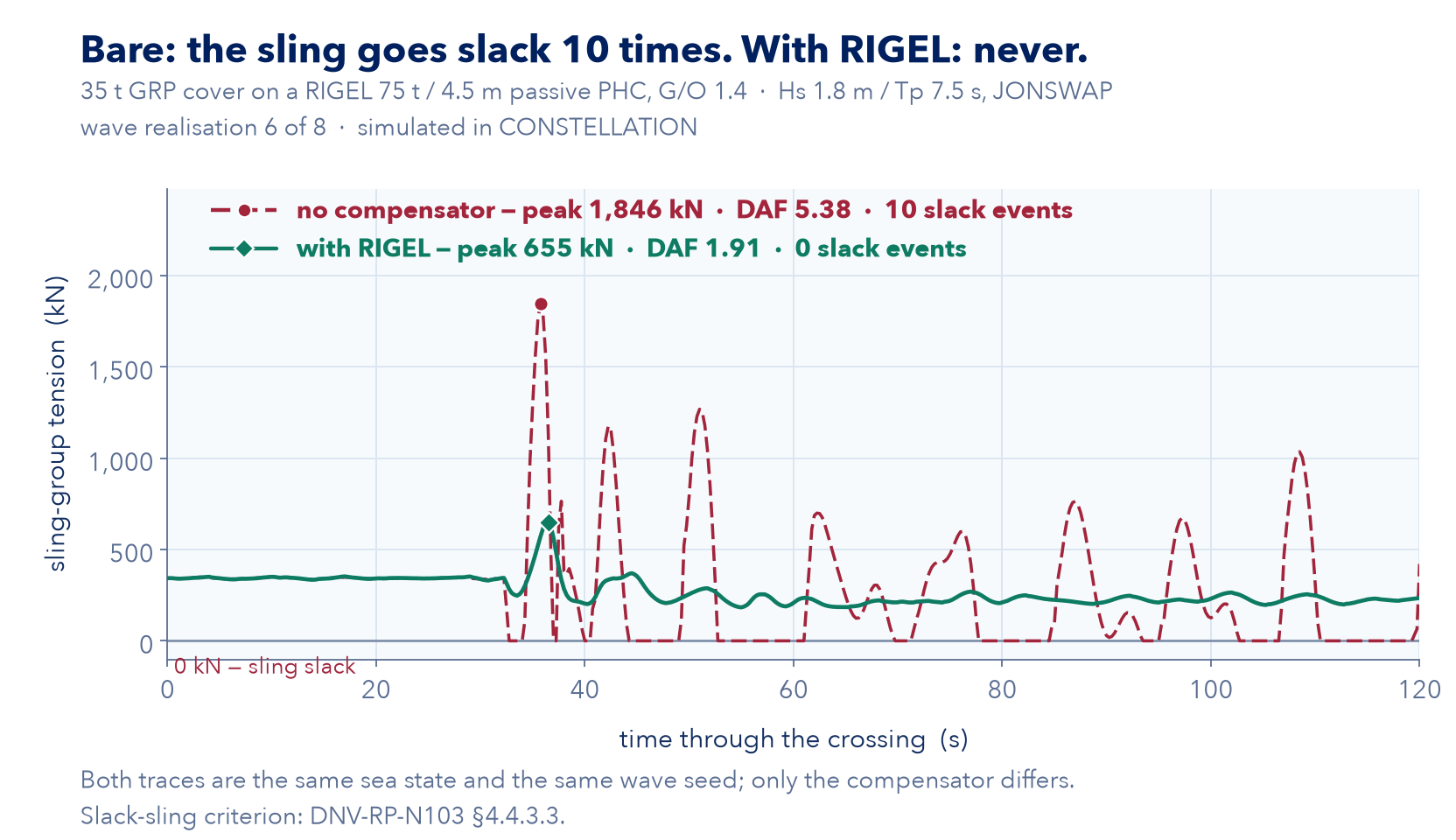
Engineering basis for this figure
- Case
- CONSTELLATION splash-zone case with the declared 35 t payload and gas/oil ratio 1.4. Both columns were produced back to back from one set of inputs.
- Version and date
- CONSTELLATION v1.2.96, run 3 August 2026.
- Operation phase
- Splash-zone crossing: lowering through the water surface. No lift-off phase and no landing phase are modelled.
- DAF definition
- Payload DAF = the maximum sling-group tension over the run divided by the payload's static weight in air, 35 t × 9.80665 m/s² = 343.2 kN. That denominator is the definition declared for this ND case. The peak is the maximum of the time series on the solver's own grid, not of the plotted samples.
- Assessed load point
- The four-leg sling group immediately above the payload. Not the hook and not the crane tip: those also carry the rigging and compensator weight, and give a different number.
- Vessel motion and sea state
- North Sea Giant: 25,397 t displacement, 161 × 30 m, draft 7.5 m, GMT 1.5 m, GML 80 m, radii of gyration 10.5 m and 38.2 m, heading 180° (stern seas; 0° is head seas in this model), six-degree-of-freedom response with the crane-tip RAO included. Irregular waves Hs 1.8 m, Tp 7.5 s, JONSWAP with the simulator's auto-derived peak-enhancement factor, 200 spectral components, water depth 30 m.
- Duration, realisations, extreme statistic
- 120 s per run, eight wave realisations (seeds 1–8) per column. The chart plots realisation 6, which carries the governing peak line load and the governing DAF in both columns. The envelope below is the worst value of each metric across the eight: no single realisation produces all four worst numbers at once.
- Payload, rigging and equipment
- 35 t GRP protective cover, 15.0 × 12.0 × 3.0 m, slam area 180 m², displaced volume 10.73 m³, released 5 m above the surface toward a 15 m target depth. Rigging: four-leg wire-rope sling group at 60°, 3.0 m legs, group stiffness 84,823 kN/m; upper sling 5.0 m at 22,619 kN/m. Crane: wire luffing, 75 t at 30 m radius, hoist stiffness 13,622 kN/m, hook 7.5 t, 20 mm wire on four falls, lowering 0.16 m/s. Compensator: RIGEL 75 t / 4.5 m stroke, passive with no EQ control, gas/oil ratio 1.4, gas datum 2,400 mm from retracted, orifice 35 % extend and 70 % retract, pre-tension 35 t.
- Hydrodynamic basis
- Water entry on the relative motion between payload and wave kinematics: buoyancy from the instantaneous submerged volume, slamming on the 180 m² water-plane area, drag at Cd 1.3, hydrodynamic added mass at Ca 2.2, and the Froude–Krylov term. These coefficients are declared case inputs and require project validation.
- Is the pair like for like?
- Yes. Both columns are the same preset on the same build, run over the same eight seeds in one session; only the compensator's presence in the load path differs. The plotted pair is realisation 6 on both sides, so the two traces see identical wave forcing.
- Governing limit
- For this ND pre-engineering screen, payload DAF ≤ 2.0 is ND’s screening default, and the snap-load ratio ≤ 0.90 is the slack-sling criterion of DNV-RP-N103, as the chart notes. With RIGEL: DAF 1.15–1.91 (8 of 8 inside the ND default), snap ratio at or below 0.359 (8 of 8), zero slack-sling events, peak sling 655 kN = 89.0 % of the unit's own 735.75 kN SWL, stroke use at the governing (retract) end 83–98 %, four of eight runs above the 90 % margin (extend end 59–77 %). Without: DAF 3.41–5.38, snap ratio 1.000, up to 11 slack-sling events. Approved project criteria supersede these defaults.
- What this is not
- Not a design-basis DAF for any other lift, not a crane-capacity check, and not an operating window. It is one commissioned case at one sea state, and it says nothing about the screen above it.
- Provenance note
- This replaces a July 2026 figure (payload DAF 1.10) from an earlier 55 t configuration and a single wave realisation. It did not reproduce, and it was withdrawn.
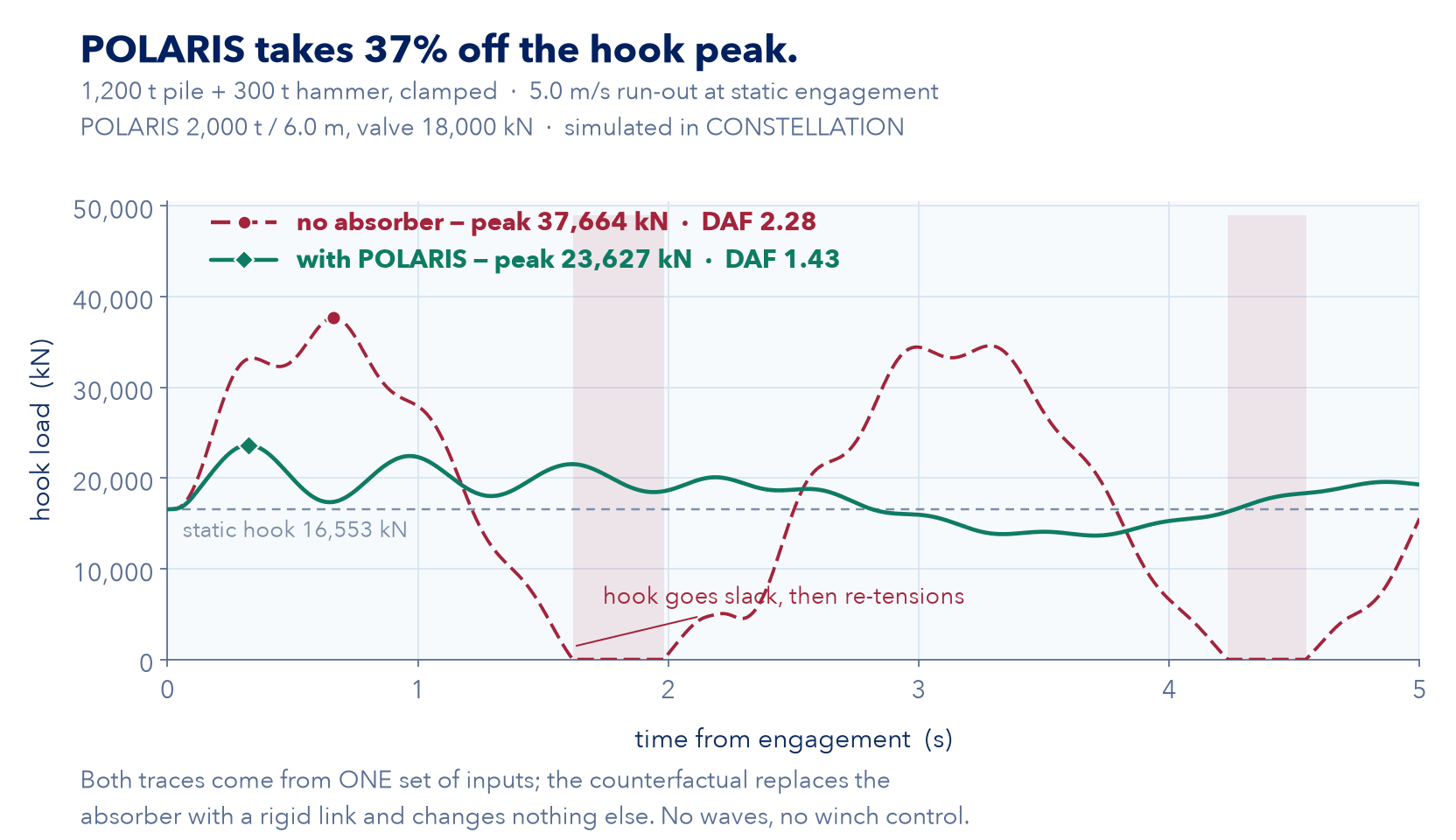
Engineering basis for this figure
- Case
- CONSTELLATION pile-run case, single velocity point at 5.0 m/s, valve force set to 18,000 kN (preset default 17,658 kN).
- Version and date
- CONSTELLATION v1.2.96, run 3 August 2026. The compensated column is the case locked on 7 July 2026 and reproduces on this build to within 0.05 % on DAF.
- Operation phase
- Pile run: the drop-and-arrest event during driving. Dry, in air, clear of the splash zone.
- DAF definition
- DAF = the maximum hook tension over the 5 s window divided by the static suspended weight at the hook: hook 160 t + POLARIS body 17.10 t + rod 10.85 t + payload 1,500 t = 1,687.95 t, i.e. 16,553 kN. The peak is tracked on the 0.05 ms integration grid, not the 1 ms output grid: reading it off the output samples under-reports a sharp arrest. Below the absorber a second DAF is reported against the payload's own 14,710 kN: 1.31 with POLARIS, 2.41 without.
- Assessed load point
- The hook and crane connector, above the absorber. The rod force below the absorber is a separate channel and a different number.
- Vessel motion and sea state
- None, deliberately. A pile run is a sub-second shock event, so the host vessel is muted and no wave loading is applied: the case isolates the arrest. There is no Hs, Tp, spectrum or heading to quote, and this figure says nothing about behaviour in a seaway.
- Duration, realisations, extreme statistic
- 5.0 s window, output every 1 ms, integrated at 0.05 ms. One deterministic run per column: no seeds and no ensemble, because there is no random forcing to average over. The quoted peak is the maximum of the time series, not a statistical extreme, and it is not comparable with an eight-seed envelope like the splash case beside it.
- Payload, rigging and equipment
- 1,200 t pile plus a 300 t hammer, clamped, 1,500 t combined impact mass, run-out 5.0 m/s. Load path: crane 17,454.3 kN/m with 66.85 kN·s/m damping, hook 160 t, upper sling 49,762.8 kN/m, POLARIS body 17.10 t, rod 10.85 t, lower sling 46,652.7 kN/m, payload 1,500 t.
- Initial velocity and absorber settings
- 5.0 m/s downward at t = 0 from full static engagement. As rigged for a pile run the soft slings hang slack and the rod stays retracted, so POLARIS carries nothing until the pile runs. The model starts once the slack is taken up and the stretched rigging carries the static weight, with the gas at its precharge. The same event reaches the slings at roughly 3.5 m/s: the weight speeds the mass up while the rigging stretches. POLARIS 2,000 t / 6.0 m stroke, valve force 18,000 kN, gas precharge force 15,696 kN, gas fraction 0.40. The run uses 4.98 m of the 6.0 m stroke (83 %) and the annular oil chamber never empties (floor 6.2 %).
- Is the pair like for like?
- Yes, and it is checked rather than asserted. Both columns are generated from one parameter set; the script compares the two field by field and refuses to run unless the absorber flag is the only difference. Same masses, stiffnesses, damping, gravity, initial state and integration step. The counterfactual replaces the compensator with a rigid link and changes nothing else.
- Governing limit
- Crane SWL 24,517 kN (2,500 t). With POLARIS the hook peaks at 23,627 kN, 96.4 % of it. Without, it peaks at 37,664 kN: 154 % of crane SWL, and the line goes fully slack and re-tensions twice inside five seconds, which no peak-load figure on its own captures.
- Independent verification
- The compensated case was cross-checked against OrcaFlex 11.3e on 17 July 2026, with the compensator reduced to a measured force law: crane peak +0.23 %, crane DAF 1.4299 against 1.4266, peak stroke −0.4 %, chain-force RMS under 1 % across the arrest.
- What this is not
- Not transferable to another pile, hammer, crane or valve setting, and not a load chart. There is no winch or operator response in the model, so the uncompensated trace after the first arrest is a free ring-down of the same chain.
- Provenance note
- Until 3 August 2026 the "without" case could not be simulated: driving the gas volume to zero to emulate a locked cylinder sends the pressure term singular, so ND first published an analytic DNV-RP-N103 snap estimate of 34,190 to 44,759 kN, depending on the crane stiffness assumed. The simulator now computes the rigid case directly: 35,387 kN on the payload side.
DAF by lift scenario
Two examples illustrate different governing mechanisms: they do not divide every offshore lift into only two regimes. The controls differ because the load patterns differ.
Crossing the water surface
At water entry, crane-tip response combines with changing buoyancy, drag, added mass and possible slam. Slack and re-tension are possible outcomes, not automatic load components. A correctly sized passive heave compensator helps maintain positive tension within its analysed force–stroke envelope; the water-entry slam itself stays a hydrodynamic (DNV-RP-N103) check.
Drivers: slam · varying buoyancy · crane-tip heave




Running a pile or heavy structure
A pile run is a loss-of-support or run-out transient: steady lowering is not itself a snap load. The released mass, run velocity, line and tackle dynamics and the arrest system determine the peak: a sharp, short-duration spike rather than a wave-cycle heave.
Drivers: snap / shock load · lowering speed · rigging stiffness

DAF: frequently asked
What is a typical DAF for an offshore lift?
How do you calculate DAF?
What is a snap load?
How much does passive heave compensation reduce DAF?
Is DAF a safety factor?
DAF and heave compensator selection
Free download · 8 pages
Offshore Lift Load Cases: ND benchmark figures
What a lift actually measures, with and without passive compensation, from Norwegian Dynamics' own time-domain simulations. It reproduces no standard: the value is the figures, which no standard publishes.
- Peak sling load and amplification, with and without a compensator, on the same sea
- The full configuration of every case, so you can set it up yourself
- Where each result stops being valid, printed next to the result
- An input checklist for scoping your own lift