
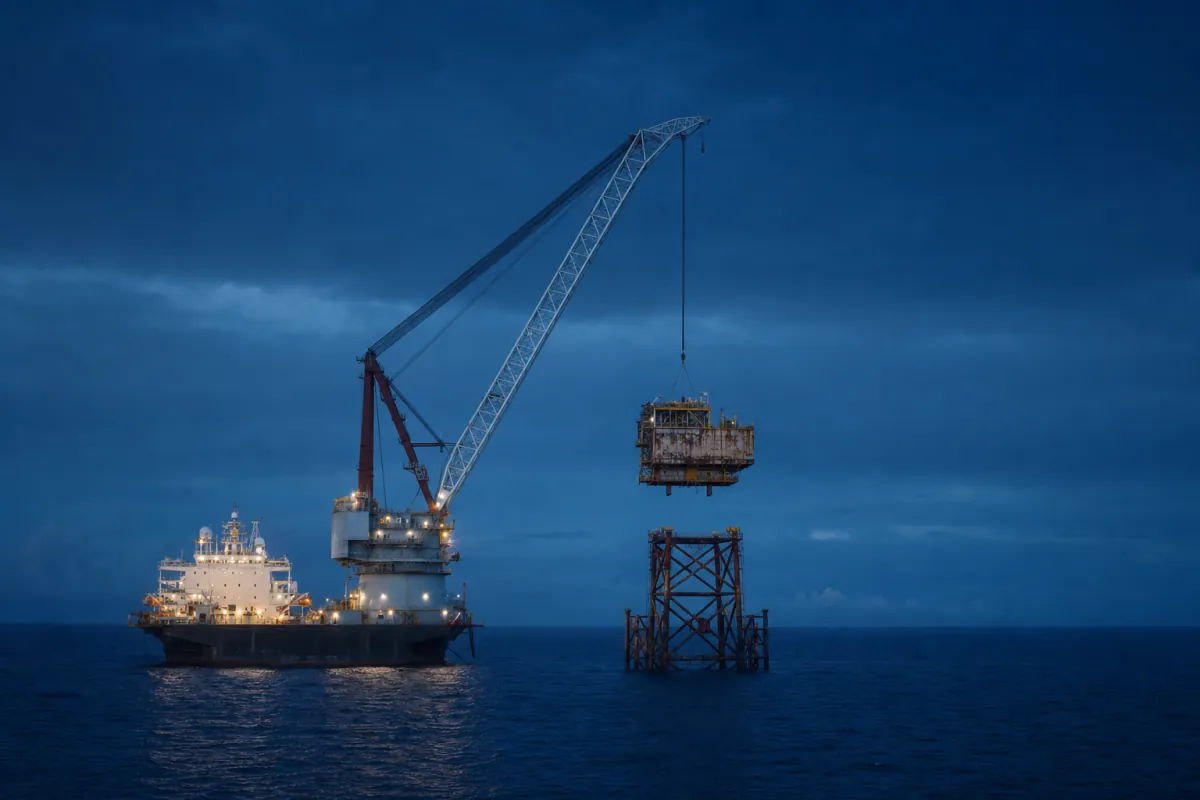
Installation in reverse — with unknown weight, tired steel and no second attempt.
Offshore Decommissioning Lifting Challenges
The Scale of Decommissioning
Over 600 offshore platforms in the North Sea alone are approaching end of life and must be removed. Globally, the decommissioning market is expected to exceed USD 80 billion over the next decade. Each removal involves reverse-engineering the original installation — cutting, lifting, and transporting structures that have been in service for 20–50 years.
Practical application: For practical application of this topic, see custom heavy lifting equipment and engineering studies and analysis.
Unlike new-build installation, decommissioning lifts face unique challenges that make them inherently more risky and unpredictable.
| New-build installation | Decommissioning removal | |
|---|---|---|
| Weight | Known from fabrication records | As-built can run 10–30% over the records |
| Structure | New steel, verified welds | Corrosion, fatigue, degraded concrete after 20–50 years |
| Lift points | Designed for the lift at hand | One-time installation pad eyes, 30 years on — verify or replace |
| Documentation | Current lifting analysis | Original analysis often unavailable |
| Sequence | One planned lift | Cut-and-lift, with load transfer at every cut |
Weight Uncertainty
The single biggest challenge in decommissioning lifts is weight uncertainty. Platform topsides accumulate material over decades — piping modifications, added equipment, marine growth on substructures, trapped water in members, and drill cuttings in legs. The as-built weight can be 10–30% higher than original design records indicate.
This uncertainty directly affects crane selection, sling design, and DAF calculations. Conservative weight estimates are essential, but over-estimation means chartering a larger (more expensive) crane vessel than necessary. Weight surveys using strain gauges and jacking tests help but cannot fully resolve the uncertainty for complex structures.
Structural Integrity Concerns
Corroded steel, fatigued welds, and degraded concrete make cutting and rigging decommissioning structures inherently riskier than handling new-build components. Lift points that were designed for a one-time installation lift 30 years ago may not be suitable for the removal lift — pad eyes may be corroded, structural members weakened, or the original lifting analysis unavailable.
In some cases, new lift points must be engineered and welded onto the structure before removal. This requires structural assessment, often using remotely operated vehicles (ROVs) for subsea components, and adds time and cost to the project.
Heave Compensation in Decommissioning
Heave compensation plays a critical role in decommissioning for several reasons:
- Margin management — with uncertain weights, a compensator provides a buffer against unexpected dynamic loads. A PHC reduces the DAF and gives the crane more margin for weight surprises.
- Weather sensitivity — decommissioning campaigns are often scheduled in summer months but still face North Sea weather. A compensator extends the weather window and reduces costly waiting-on-weather days.
- Landing control — placing removed topsides onto cargo barges requires controlled lowering. A compensator prevents hard landings that could damage both the structure and the barge.
- Shock protection — during cutting operations, sudden load transfer events can send shock loads through the crane system. A shock absorber like POLARIS protects the crane from these transient forces.
Risk → mitigation, on one line each
| Risk | Where it comes from | Mitigation |
|---|---|---|
| Weight surprise | Decades of modifications, marine growth, trapped water, drill cuttings | Conservative estimates, strain-gauge and jacking surveys, and dynamic-load margin — a passive compensator lowers the DAF and buys buffer |
| Lift-point failure | Corroded pad eyes, fatigued members, missing analysis | Structural assessment (ROV subsea); engineer and weld new lift points where needed |
| Cutting load transfer | Sudden release as members are cut | Shock absorption — POLARIS caps the transient through the crane |
| Waiting on weather | North Sea conditions, even in summer campaigns | Compensation widens the operational Hs limit — see weather windows |
| Hard barge landing | Relative motion between crane and cargo barge | Compensated, controlled lowering onto the barge |
For heavy removals the capacity band matters too — CYGNUS covers passive compensation up to 10 000 t.
Decommissioning lifting — frequently asked
Why are decommissioning lifts riskier than installation?
How much can the actual weight differ from records?
How is weight verified before the lift?
What does heave compensation contribute?
Can the original lift points be reused?
Related on Norwegian Dynamics
- Subsea Lifts — Drag and added-mass calculation, worked examples.
- Weather Windows for Offshore Lifting — Hs limits, alpha factors and the cost of waiting.
- Splash Zone Crossing — The worst phase of any subsea lift.
Working on a lift that needs this?
Old structures are awkward shapes — drag and added mass dominate. Send the structure outline and we'll come back with sizing.