
An offshore crane vessel at dusk under a passing weather front, the squall line crossing a clear warm horizon
KNOWLEDGE HUB / OFFSHORE PLANNING

Weather Windows and Operational Limits

The conditions must hold for the time the operation needs.

By Norwegian Dynamics Engineering · · Reviewed · 7 min read
THREE DIFFERENT OUTPUTS

An envelope, a window and a campaign result.

Each answers a different question. Moving from one to the next needs more project information.

1 · Dynamic analysis

Operating envelope

Which conditions satisfy the defined response criteria for the lift?

Required data and output
Required project input
Vessel, crane, payload, rigging, compensation system and lift phase
Output
Case-specific Hs/Tp operating envelope
2 · Time-series screen

Executable window

Do conditions remain acceptable for the complete required period?

Required data and output
Required project input
Site and season data, required continuous duration, forecast and alpha criteria
Output
Executable windows, including persistence
3 · Campaign simulation

Waiting time & cost

What delay and cost follow from the planned activities and their windows?

Required data and output
Required project input
Mobilisation, sequence, downtime logic and contracted day rate
Output
Waiting days and cost distribution
SCHEMATIC EXAMPLE / EQUAL TIME INTERVALS

Continuity determines which periods are usable.

Both rows meet the criterion in 8 of 12 intervals. This example requires four consecutive intervals.

Illustrative requirement: at least four uninterrupted intervals inside the criterion.

A / Fragmented availability

8 of 12 intervals inside the criterion

  1. ×
  2. ×
  3. ×
  4. ×
0 qualifying continuous runs

B / Longer continuous runs

8 of 12 intervals inside the criterion

  1. ×
  2. ×
  3. ×
  4. ×
2 qualifying continuous runs
✓ Blue · within criterion× Hatched · outside criterion

This is an explanatory sequence, not a weather record or a project screen. An actual operation uses its declared reference period and all applicable criteria.

THE PUBLISHED OBSERVATION SCREEN

What changing the threshold does in this record.

NDBC 41002 · 12 February–24 March 2023 · continuous windows of at least 24 hours.
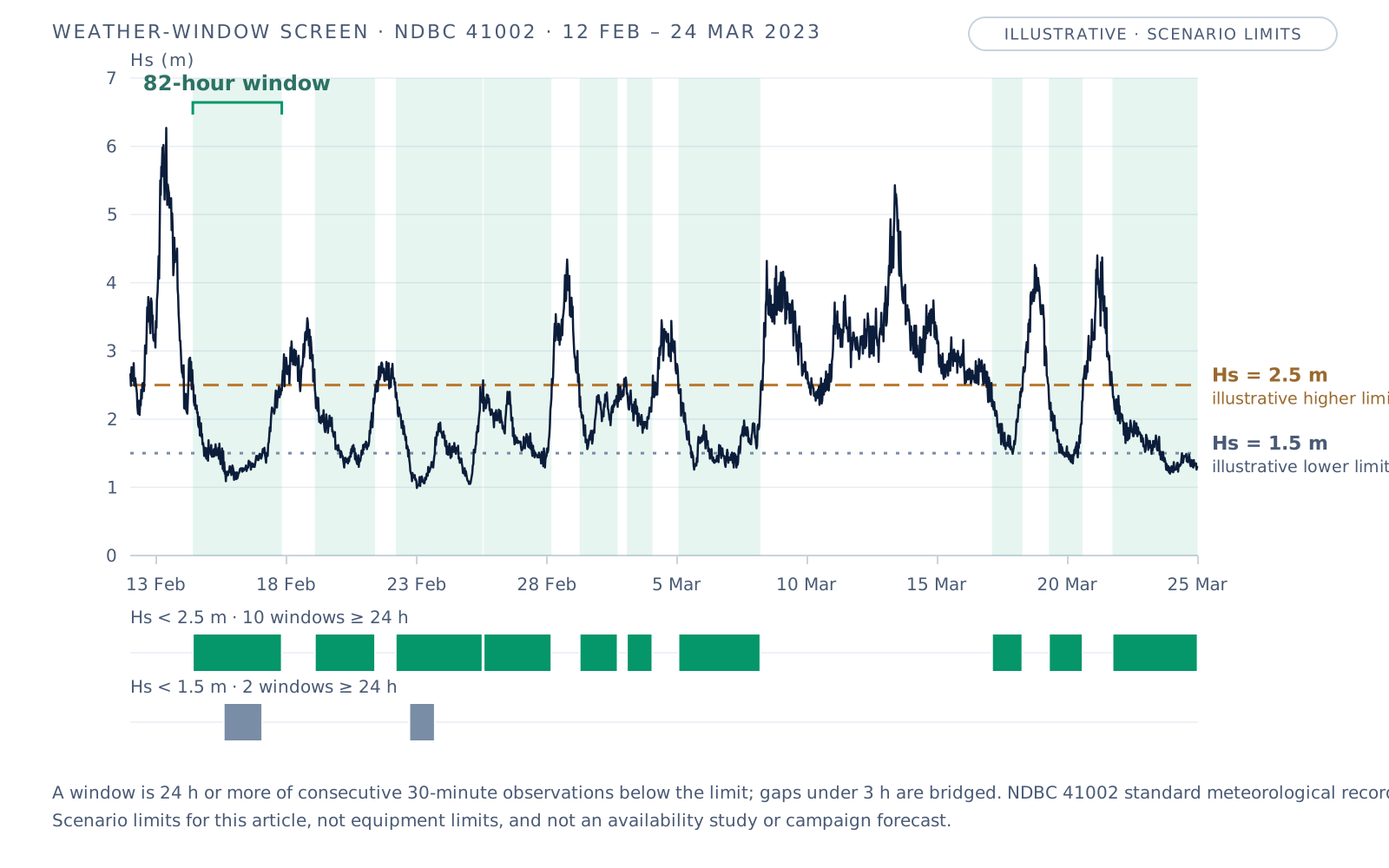
Six-week NDBC 41002 buoy observation record screened at illustrative Hs limits of 1.5 m and 2.5 m; ten continuous windows of at least 24 hours at the higher threshold versus two at the lower threshold
Figure 1 — Six weeks of NDBC 41002 buoy observations, 12 February–24 March 2023, screened for continuous windows of at least 24 hours. The illustrated thresholds (Hs = 1.5 m and 2.5 m) produce two and ten windows respectively. They are scenario inputs, not generic uncompensated/compensated limits; this is a threshold-screening illustration, not an annual availability study or campaign forecast.

Open full-resolution chart ↗

The thresholds are scenario inputs. The 1.5 m and 2.5 m cases are not generic uncompensated/compensated limits. A project operating envelope must come from its own analysis.

Basis and assumptions

The figure uses buoy observations from NOAA NDBC 41002 in the western Atlantic, covering 12 February to 24 March 2023. Windows are continuous runs of at least 24 h below the two illustrated Hs thresholds, counted with the same uptime engine used in a CONSTELLATION study. The 1.5 m and 2.5 m thresholds are scenario inputs, not generic operating limits and not outputs of a compensator design. This six-week screen is not an annual-availability study or a campaign forecast; those require the project site, season, duration, operating envelopes, forecast rules and contract assumptions. A site-specific operability screening supplies that basis.

The detailed guide follows: definitions, campaign costs, compensation benefit and the nominated planning basis.

What is a Weather Window?

A weather window is a continuous period during which all criteria required for a specific operation remain acceptable for its required reference period. It is more than a favourable condition at the start of the lift.

Significant wave height (Hs), commonly described as the average height of the highest third of waves, is one planning input. The allowed conditions depend on the vessel, crane, payload, rigging, equipment and operation; wave period and other relevant criteria are part of the declared basis.

Why Weather Windows Matter for Project Cost

Waiting-on-weather cost depends on the simulated delay and the contracted vessel rate. Establish the campaign assumptions before attaching a cost to a change in operating limits.

The campaign effect, waiting days and vessel cost, comes from a time-series campaign simulation on the project metocean data, with the operation durations, forecast criteria and contracted dayrates in it. That simulation, not an annual percentage, is what the commercial case rests on.

Apply the project’s forecast-uncertainty and monitoring rules. A wider analysed envelope does not replace the forecast criteria, decision rules or contingency allowance for the operation.

  1. Screen both cases. Apply the analysed uncompensated and compensated envelopes to the same project metocean time series.
  2. Count usable runs. A percentage of samples below a threshold is not enough; each window must remain inside the criteria for the operation’s full reference period.
  3. Price the simulated delay. If a campaign simulation returned 10–15 fewer days, then USD 50k–500k per day gives USD 0.5–7.5 M. That is arithmetic, not a project prediction.

The compensated Hs limit comes from analysis — a CONSTELLATION lift-and-heave study documents it. The forecast and reference-period mechanics are on the DNV-ST-N001 page.

How Heave Compensation Expands Weather Windows

A passive heave compensator decouples the payload from the crane tip motion, reducing the dynamic amplification factor (DAF). How much it removes, and how much workable Hs that buys, is a case result for a stated load channel and lift phase, which is exactly what the lift analysis reports.

There is no fixed conversion from load reduction to allowable Hs: vessel response, hydrodynamic loading, stroke and the governing criterion all move with the sea state, so the envelope is recomputed rather than scaled.

For seasonal installation campaigns (particularly in the North Sea, Barents Sea, or offshore West Africa) this capability extension can be the difference between completing the scope in one mobilisation or needing to return the following season. An ANTARES adaptive compensator is specifically designed for campaigns where the operating range must be as wide as possible.

Planning Lifts Around Weather

Document the operational criteria and reference period in the lift procedure. The nominated project basis and reviewer appointments determine the required review and approval scope.

  • Operating criteria — the wave-height and period limits and any other applicable conditions for the operation.
  • Reference period — the time the criteria must cover, including the planned operation and assessed contingency under the nominated basis.
  • Forecast treatment — uncertainty treatment, decision rules and monitoring requirements selected for the operation.
  • Review responsibilities — the appointed MWS, client, class or other review scope, as applicable.

Compare campaign cases using documented operating envelopes and task durations. Any change in execution time must be justified in the operation plan, rather than assumed from the presence of a compensator.

Weather windows — frequently asked

What is a weather window in offshore lifting?
A continuous period during which all required conditions stay within the operation’s criteria for the complete reference period. Passing a criterion at the start is not sufficient.
What Hs limit applies to an offshore lift?
There is no generic compensated or uncompensated limit. It is established for the actual vessel, crane margin, payload, rigging, compensation system, lift phase and governing criteria, then adjusted for the forecast and procedure requirements.
How much does waiting on weather cost?
Waiting-on-weather cost is simulated waiting days multiplied by the contracted day rate. As arithmetic only, 10–15 days at USD 50k–500k per day is USD 0.5–7.5 million; without a campaign simulation, it is not a project forecast.
How does heave compensation widen the weather window?
Compensation can reduce suspended-load dynamics, but the resulting Hs limit and executable-window count must be recomputed for the actual case. The six-week figure is a threshold-screening illustration: ten windows of at least 24 h at Hs ≤ 2.5 m and one at Hs ≤ 1.5 m.
What weather criteria does the lift procedure define?
State the operating criteria, required reference period and contingency, forecast-uncertainty treatment, monitoring and decision rules. Use the contract-nominated standard and project basis, with reviewer responsibilities defined by the appointment and contract.

Related on Norwegian Dynamics

Trying to widen your weather window?

Send the operation sequence and available vessel, payload and metocean data. We can define the analysis and weather-window assessment scope for the project.

Related products

  • ANTARES — Adaptive passive heave compensator
  • CONSTELLATION — In-house lift simulation

Related reading
