
Sea-state operability screening for an offshore lift.
CONSTELLATION, our in-house time-domain lift simulator, models a defined operation from deck to seabed and classifies a declared Hs×Tp grid against named project criteria. That gives a sea-state envelope. Weighted operability and a continuous weather window require site-specific metocean data and persistence analysis.
By Norwegian Dynamics Engineering · · Reviewed · 4 min read
Where CONSTELLATION fits
CONSTELLATION solves the defined operation from first principles: the payload equation of motion with real-gas gas-spring thermodynamics, Morison hydrodynamics, and time-domain splash-zone and landing response. DNV-RP-N103 informs the analysis method; the contract-nominated edition and the project’s acceptance criteria govern execution work. The model couples crane, vessel, rigging, compensator and payload.
First-principles, coupled
The complete load path (crane, vessel, rigging, compensator, payload) solved as one time-domain model, not a static factor.
Screened on a declared grid
Each Hs×Tp cell also needs a fixed heading, spectrum and spreading, current, water depth, vessel condition, simulation duration and extreme basis.
The governing limit, named
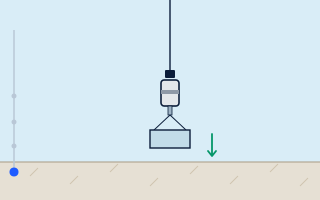
We tell you which gate binds (splash DAF, landing, touch-down speed or stroke) and by how much margin.
Modelled, not certified
A pre-engineering sea-state screen on the stated ND basis. It is rebuilt against the project basis, nominated standards edition and approved criteria before issue.
An illustrative sea-state envelope
The visual below illustrates a compensated-screen layout for a ~190 t subsea structure on the ANTARES 250 t at head sea. It is not a published project run and its numerical cells are not transferable. A project result requires the complete basis listed below.
The example boundary passes Hs 2.5 m at Tp 8 s. The ring marks the illustrative Hs 2.0 m cell. Blank cells behind the dashed line are steeper than the DNV-RP-C205 limit: such seas do not occur, so they are not screened. These are demonstration values, not an approved operating limit.
What we simulate
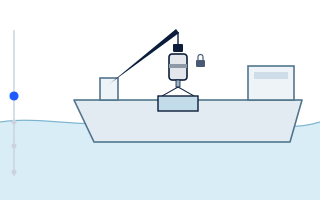
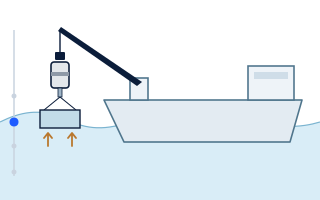
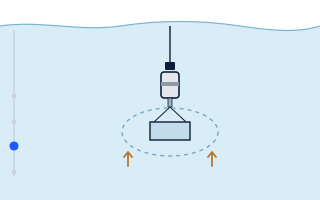
A project screen can use one continuous run from deck to seabed rather than a static check. The compensator model switches gas mode per phase as the load goes overboard and submerges.
Four results that must not be conflated
Sea-state envelope
An unweighted grid classification for the declared Hs, Tp, heading, spectrum, spreading, current, water depth and vessel condition.
Weighted operability
The envelope combined with a named site, season and metocean distribution. The weighting basis and exclusions must be reported with the percentage.
Continuous weather window
A forecast or time-series screen with task duration, persistence, interruptions and forecast uncertainty. See Weather Windows.
Compensator benefit
A difference established from matched compensated and uncompensated runs using the same forcing, response point, seeds, duration and extreme basis.
Basis required for a project screen
Load path
Payload and buoyancy states; rigging geometry, stiffness and pretension; crane-tip or winch model; compensator force–stroke data and end stops.
Vessel and environment
Vessel RAOs and condition, response point and heading; spectrum and directional spreading; current, water depth and hydrodynamic coefficients.
Simulation record
Declared Hs×Tp grid, time step, ramp, duration, number of seeds, random-seed policy and statistical or extreme-value treatment.
Decision basis
Project acceptance criteria, nominated standards editions, matched baseline where benefit is claimed, plus climatology or time series and persistence when availability or weather windows are reported.
The gates we check
Each screened sea state must clear every acceptance gate to count as workable.
| Acceptance gate | Illustrative default | Ownership |
|---|---|---|
| Splash-zone crossing DAF | ≤ 2.0 | ND pre-engineering default; analysis method informed by DNV-RP-N103 |
| Slack-sling events | = 0 | ND pre-engineering default; project minimum-tension requirement governs |
| Landing DAF | ≤ 2.5 | ND-DS-10 screening default |
| Touch-down speed | ≤ 0.5 m/s | ND-DS-10 screening default |
| Stroke utilisation | ≤ 90 % | ND-DS-10 screening default |
These values are ND screening defaults, not limits stated by DNV-RP-N103 and not project-specific certified criteria. The project’s approved acceptance criteria and contract-nominated standards editions supersede them.
What this compensated illustration reports
These outputs describe the compensated illustration only. They do not quantify compensator benefit; that requires a matched uncompensated run on the same basis.
Screen your operation
Send us the structure, vessel, site and task basis. We can return a sea-state envelope, its governing criterion and a recommended compensator setup; add site-specific metocean and persistence inputs for weighted operability or a continuous weather-window assessment.
CONSTELLATION results are engineering predictions using analysis methods informed by DNV-RP-N103 and the stated ND modelling basis, not a certified analysis. Project limits are issued only after the contracted vessel, metocean, standards edition, acceptance criteria and run record are fixed.
