
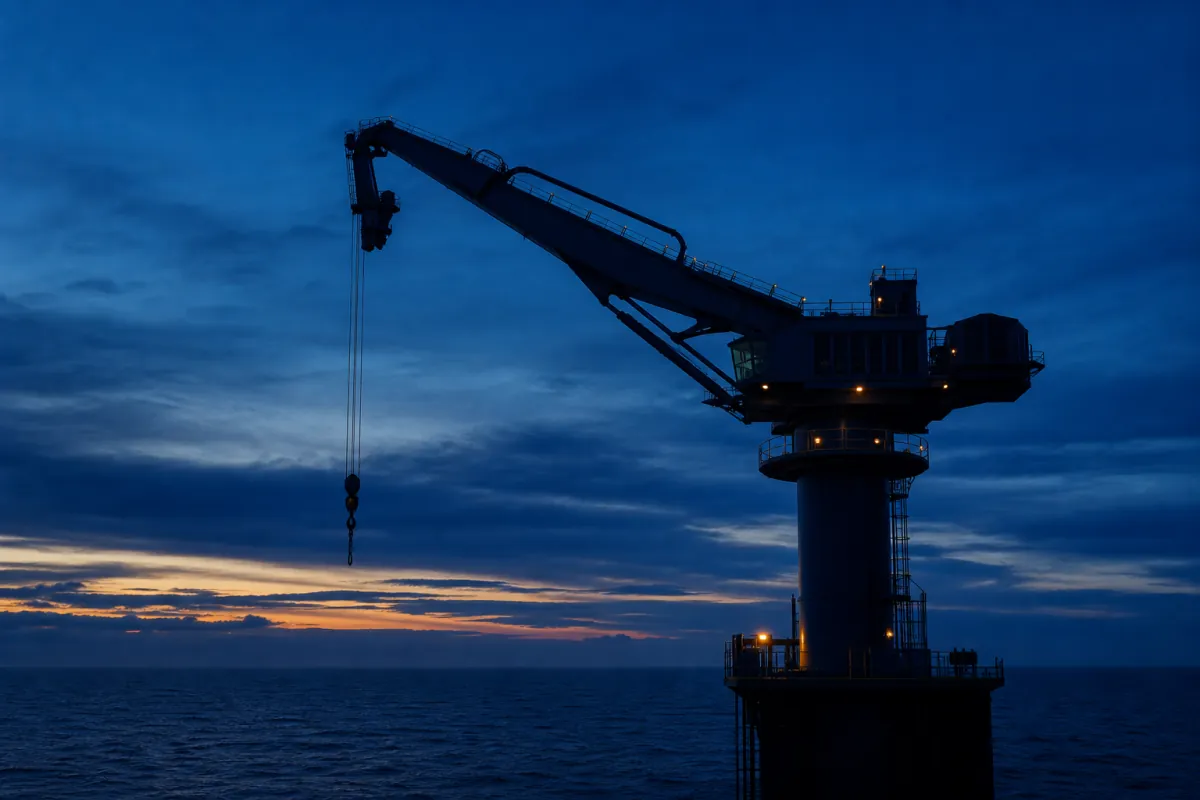
Knuckle, stiff boom, ram luffing — the geometry decides how much of the sea reaches your hook.
Offshore Crane Types Compared
Main Types of Offshore Cranes
Offshore cranes fall into several categories based on their boom geometry and luffing mechanism:
Practical application: For practical application of this topic, see POLARIS crane shock absorber and product / system design.
- Knuckle boom cranes — the most common type on offshore platforms and supply vessels. The boom has an articulating joint (knuckle) that allows the boom to fold for stowage. Capacities from 5 to 300+ tonnes. Manufacturers include Liebherr, NOV (National Oilwell Varco), and Palfinger.
- Stiff boom (fixed boom) cranes — a straight boom without articulation. Typically higher capacity and longer reach than knuckle boom cranes. Used for heavy lifts and construction operations. Common on semi-submersible crane vessels (SSCVs).
- Ram luffing cranes — the boom angle is controlled by a hydraulic ram rather than a wire rope. Provides precise load positioning and is common on jack-up rigs and drilling platforms. Favell, SMST, and Huisman manufacture these.
- Pedestal cranes — a general category for cranes mounted on a fixed pedestal, which can use any boom type. The pedestal allows full 360° rotation.
| Type | Boom / luffing | Capacity & use | Typically seen on | Compensation note |
|---|---|---|---|---|
| Knuckle boom | Articulating joint; folds for stowage | 5 – 300+ t | Platforms, supply vessels | Some inherent compliance at the knuckle |
| Stiff / fixed boom | Straight boom, no articulation | Higher capacity, longer reach; heavy lift & construction | SSCVs | Stiffest path — gains most from compensation afloat |
| Ram luffing | Boom angle set by hydraulic ram | Precise load positioning | Jack-ups, drilling platforms | Precision handling; dynamics still per sea state |
| Pedestal | Any boom type on a 360° pedestal | General category | Fixed installations | Mounting, not geometry — boom type governs |
How Crane Type Affects Heave Compensation
The crane type influences heave compensation requirements in several ways:
Boom stiffness: A stiffer boom transmits more of the vessel heave to the crane tip, increasing the dynamic amplification factor. Stiff boom cranes on floating vessels generally benefit more from heave compensation than knuckle boom cranes, which have some inherent compliance at the knuckle joint.
Wire rope length: Longer wire rope runs act as springs, changing the natural frequency of the lifting system. Resonance between wave period and the system natural period must be avoided — a heave compensator shifts the natural period away from typical wave periods.
Integration: Active heave compensation (AHC) is typically integrated into the crane winch drum. Passive heave compensation (PHC) is installed in the wire rope path between the crane hook and the payload — this makes PHC systems crane-independent and suitable for any crane type.
A RIGEL or ANTARES compensator can be deployed on any crane because it sits below the hook, independent of the crane own systems.
Every offshore crane has a load chart that specifies maximum safe working load (SWL) as a function of boom angle and radius. The load chart assumes static conditions — actual dynamic loads during a lift can exceed the chart values due to vessel motions.
DNV and NORSOK standards require that dynamic loads be accounted for in lift planning. The total hook load must remain below the crane SWL at the planned radius, including the dynamic amplification factor, rigging weight, and any subsea forces (drag and added mass).
A heave compensator effectively increases the usable crane capacity for a given sea state by reducing the dynamic component of the load.
Offshore crane types — frequently asked
What are the main types of offshore cranes?
Which type is most common?
How does the crane type affect heave compensation?
Can I use a heave compensator on my existing crane?
Do load charts already include dynamic loads?
Related on Norwegian Dynamics
- Crane Load Chart — Velocity formula, DAF derating, worked example.
- DNV Standards for Offshore Lifting — ST-0378, ST-N001, RP-N103 and how they apply to compensators.
- Heave Compensator Selection — Choose between PHC, APHC and AHC for your envelope.
Working on a lift that needs this?
Compensators sit below the hook — independent of the crane. If you have a crane and a problem load case, we can fit a solution.