Active vs Passive Heave Compensation
A passive compensator lets a gas spring absorb the vessel’s motion. An active compensator measures the motion and drives against it. How they differ in power, sensing, response and failure behaviour, and when each is the right choice.
- Passive heave compensation puts a gas spring and a damper in line between crane and load. It needs no sensor and no power to compensate, and it removes most of the motion in waves well shorter than its natural period.
- Active heave compensation measures the vessel’s motion with a motion reference unit (MRU) and drives a winch or cylinder against it. It is not tied to a natural period, but it needs power, sensors and control, and its stroke, speed and power set its limits.
- Adaptive passive sits between the two: a passive gas spring whose stiffness, damping and equilibrium are set for each phase of the lift.
- For most subsea lifts a correctly sized passive unit is enough. Active pays off when a load must follow a fixed point closely, in long swell a passive unit cannot isolate, and in topside motion compensation.
Both approaches reduce what vessel heave does to a suspended load: the snap loads in the rigging, the motion at the load and its speed at landing. They differ in where the correcting force comes from. In a passive system it is energy stored in compressed gas, taken up and given back as the crane tip moves. In an active system it is power from a drive, commanded by a controller that measures the motion.
What differs
Passive. The unit hangs in the line, rod down to the load. Above the working piston is vacuum; below it, on the rod side, is oil, connected through a damping restriction to a gas accumulator. When the vessel lifts the crane tip, the cylinder extends, pushes oil into the accumulator and compresses the gas, so the line tension rises gently instead of in a jolt. When the tip drops, the gas pushes the oil back. The oil squeezed through the restriction damps the motion. Nothing is measured and nothing is driven. Our passive heave compensation article goes through the model.
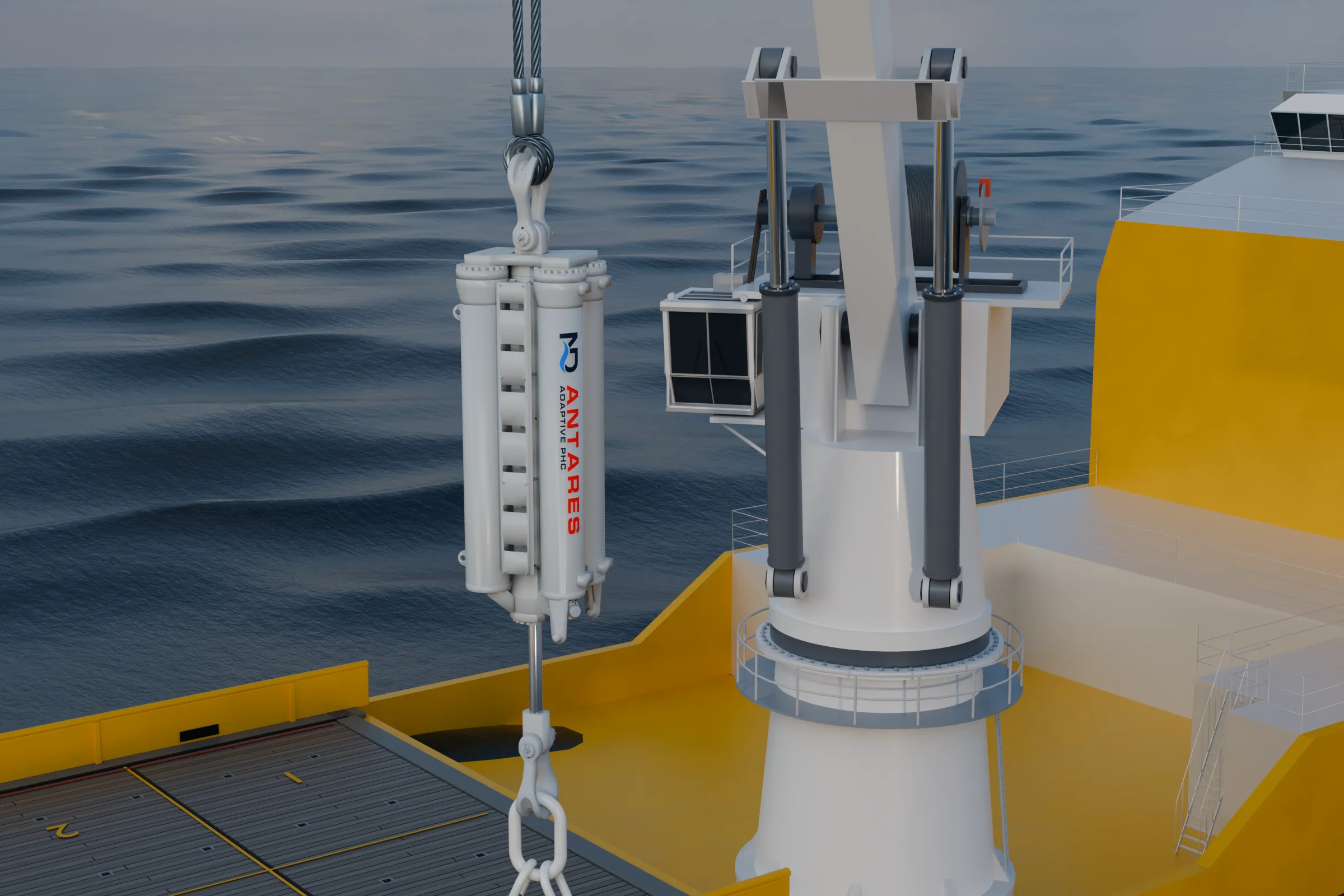
Adaptive passive. The same passive gas spring carries the load, but the unit switches between operation modes during the lift, setting its stiffness, damping and equilibrium for each phase: stiffer and better damped through the splash zone, softer in the water column, and free for a soft set-down at landing. It can also use its stroke to lift a load clear of a moving deck faster than the hoist alone. See adaptive passive heave compensation.
Active. An MRU measures the vessel’s motion; the controller works out the motion at the crane tip and commands a drive to cancel it. In most active systems the drive is the crane’s winch, fed by a hydraulic power unit or an electric drive on the vessel. An in-line active unit puts a driven cylinder below the hook instead, and a gas spring can carry the static load so the drive only moves it. Active heave compensation covers the types and what they cost to run.
Side by side
| Passive | Adaptive passive | Active | |
|---|---|---|---|
| What carries the load | A gas spring: accumulator gas over the cylinder’s oil | The same passive gas spring | A driven winch or cylinder, often with a gas spring carrying the static load |
| Where the correcting force comes from | Energy stored in the gas as the unit extends, given back as it retracts | The same, with stiffness, damping and equilibrium set for each phase | Drive power, commanded from the measured motion |
| Sensing | None | The unit’s own sensors, for its automatic control | An MRU on the vessel, plus the drive’s own position feedback |
| Power for compensation | None. RIGEL is set by hand on deck; CYGNUS has a small battery for its adjustment functions | A medium onboard battery on ANTARES, no umbilical | Continuous: usually a hydraulic power unit or electric drive on the vessel. VEGA, in development, uses a large onboard battery and no umbilical |
| Wave periods it handles | Waves well shorter than its natural period; longer waves are amplified | As passive, with its settings matched to each phase | A wider range, up to its stroke, speed and power |
| If power or a sensor fails | Compensation needs neither, so it carries on; gas pressure and seals are checked before the lift | The gas spring still carries the load; the setting it falls back to is part of its design | Depends on the design: with a gas spring under the load it falls back to passive behaviour; without one, the drive has to hold or lower the load safely |
| What there is to maintain | Cylinder, accumulator, restriction; gas pre-charge checked per operation | Adds control valves, a controller and a battery | Adds the MRU, controller, drive, power supply and software, with commissioning and tuning |
| Typical use | Splash-zone crossings, subsea lowering and landing, lift-off from a moving deck | Lifts whose phases need different settings; quick lifting | Landing within a tight tolerance, holding a load steady over the seabed, topside motion compensation |
| In our range | RIGEL, 55–1,000 t; CYGNUS, 12.5–10,000 t | ANTARES, 30–4,000 t | VEGA, in development: 75–2,500 t design targets |
| Entry price, our range | From about USD 15,000 (CYGNUS) and USD 35,000 (RIGEL) | From about USD 100,000 (ANTARES) | VEGA is in development |
Prices are the budget figures on our product pages; a project price depends on capacity, stroke, class and scope.
Why wave period decides between them
A passive compensator and its load form a spring and a mass, with a natural period set by the load and the gas volume. How much of the hook’s motion reaches the load depends on how the wave period T compares with that natural period T_n. Without damping:
The load moves less than the hook only when T < T_n / \sqrt{2}. So a passive unit is sized with a natural period well above the wave periods of the operation: the longer the stroke and the larger the gas volume, the softer the spring and the longer the natural period. In the worked example on our passive article, a 16 s natural period leaves the load with about a third of the hook’s motion in 8 s waves.
For waves longer than that, the load moves more than the hook, most of all near the natural period, and only in swell far longer than the natural period does it come back to the hook’s own motion. So long-period swell is where a passive unit struggles, and where active compensation earns its place: it measures the motion and drives against it at whatever period the sea brings, up to the limits of its stroke, its speed and its power supply. Its residual motion depends on how accurately and how quickly it measures, and on how fast the drive can follow.
If power or a sensor fails
A passive unit needs no power to compensate: as long as it holds its gas and oil, it keeps working. In an adaptive passive unit the gas spring still carries the load if its control stops; which setting it falls back to is part of its design and is checked in the lift plan. An active system depends on its design. Where a gas spring carries the static load, losing the drive leaves a passive unit in the line. Where the drive carries the whole load, the system has to hold or lower it safely on its own brakes and valves, and that fallback is part of what the lift plan checks.
When to choose which
- Start with passive. If the operation’s wave periods sit well below a natural period the available stroke can give, and the aim is lower snap loads, less motion at the load and a softer landing, a passive unit does it with no power and little to maintain.
- Go adaptive when one setting cannot suit the whole lift: a splash-zone crossing followed by a precise landing, or a lift-off from a moving deck that needs a quick lift.
- Go active when the load has to follow a fixed point within a tight tolerance, when the swell is too long for the stroke you have, or for topside motion compensation.
The heave compensator selector walks through the same questions for a given lift, and a lift model in CONSTELLATION shows the response of each option in the operation’s own sea states.
Frequently asked questions
What is the difference between active and passive heave compensation?
A passive compensator puts a gas spring and damping in line between crane and load; it needs no sensor and no power to compensate. An active compensator measures the vessel’s motion with an MRU and drives a winch or cylinder against it, which takes power, sensors and control. Adaptive passive keeps the passive gas spring and changes its settings between lift phases.
Is active heave compensation better than passive?
Not in general. A passive unit sized with a natural period well above the operation’s wave periods removes most of the motion with nothing to power or tune. Active is the better choice where a load must follow a fixed point closely, in long swell that the available stroke cannot isolate, and in topside motion compensation.
How much motion does each remove?
It depends on the case, not on the label. For a passive unit the motion ratio follows from the wave period and the unit’s natural period: in our worked example, a 16 s natural period leaves about a third of the hook motion in 8 s waves. An active system’s residual motion depends on how accurately and quickly it measures and how fast its drive can follow.
Does passive heave compensation need power?
Not to compensate: the gas spring and the damping act on their own. Some passive units carry a small battery for adjustment functions, as CYGNUS does. An adaptive passive unit such as ANTARES uses a battery for its automatic damping control, still with no umbilical.
What happens if an active system loses power?
It depends on the design. Where a gas spring carries the static load, the unit falls back to passive behaviour. Where the drive carries the whole load, the system has to hold or lower it safely on its brakes and valves, and that fallback is checked in the lift plan.
Where does adaptive passive heave compensation fit?
Between the two. A passive gas spring carries the load, and the unit switches between operation modes during the lift, setting stiffness, damping and equilibrium for each phase: for example stiffer and better damped through the splash zone, and free for a soft set-down at landing. It suits lifts whose phases need different settings, and quick lifts off a moving deck.
Sources and assumptions
- Product ranges, power arrangements and budget prices are from our product pages. VEGA figures are design targets; VEGA is in development.
- The motion-ratio expression is the undamped single-degree-of-freedom result used in our passive heave compensation article; Figure 2 adds 10 % damping, which caps the resonance and changes the 8 s value from 0.33 to 0.36.
- Failure behaviour is described by architecture. The actual fallback of a given system is part of its design documentation and the lift plan.
Choosing between passive and active?
Send the lift phases, the vessel, the payload and the sea states. We’ll model the options in CONSTELLATION and recommend the simplest one that keeps the lift within its limits.
Send your lift case →