
Arresting a pile run: 1,500 t at 5 m/s on a POLARIS shock absorber
What a crane shock absorber does to the arrest load when the soil lets a driven pile go — the same event, computed with and without the absorber from one set of inputs.
Governing result
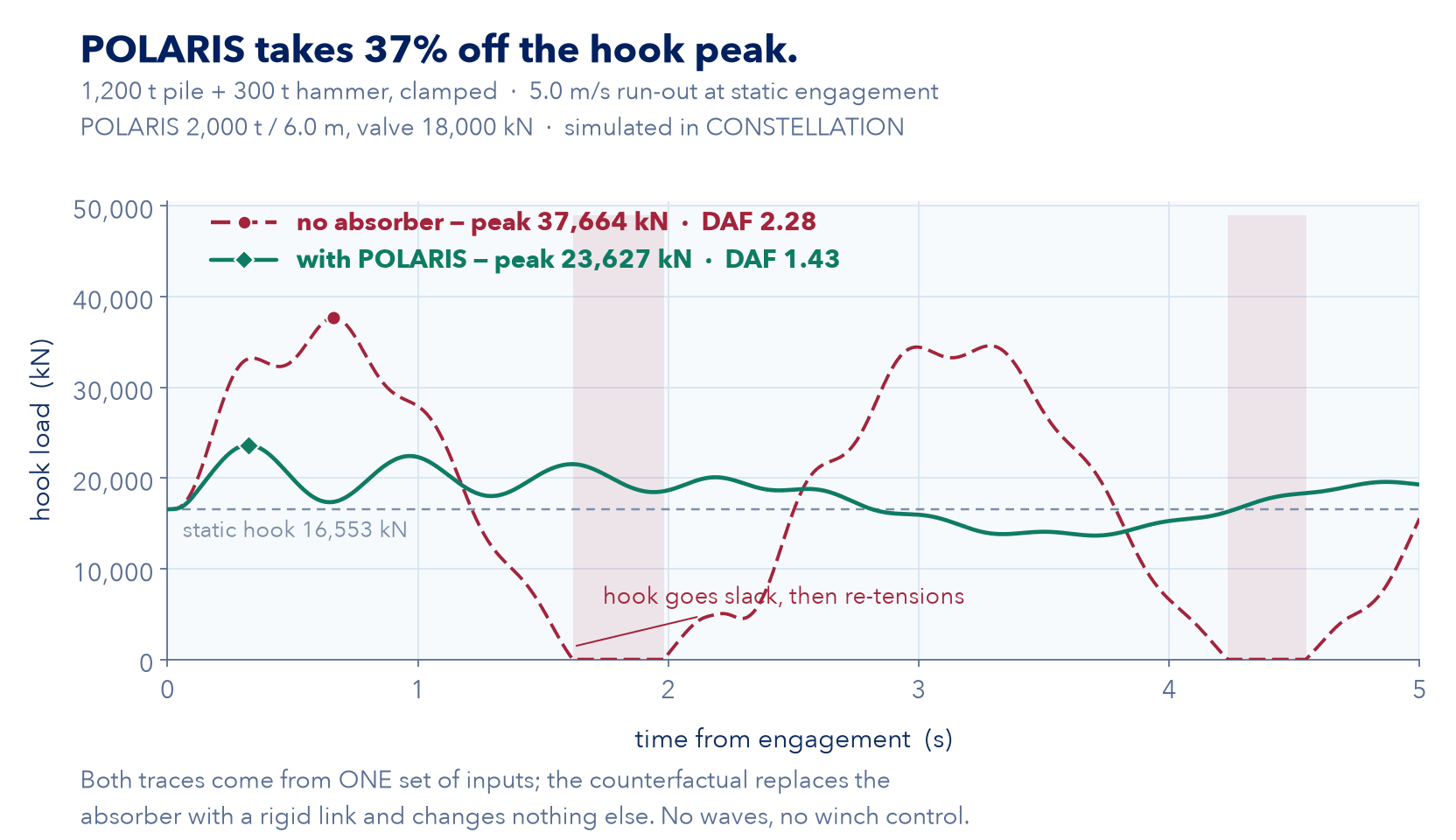
In the matched rigid-link run, peak hook load is 37,664 kN — 154% of the stated crane SWL. With the POLARIS 2,000 t / 6.0 m unit in the same model, it is 23,627 kN (96.4% of SWL), with no full-slack event during the five-second arrest window.
When the soil lets go
During driving, the soil’s grip is what carries a pile. When a weak layer releases it (a pile run) the pile and the hammer clamped to it accelerate downward together, and whatever the crane still holds must arrest the moving mass. Here that mass is 1,500 t: a 1,200 t pile with a 300 t hammer, moving at 5.0 m/s when the line comes taut.
This is a sub-second shock, not a lift in waves. The vessel is muted and no sea state is applied, so the case isolates what the load path itself does with the energy. The comparison is like for like: both columns run from one parameter set, and the counterfactual replaces the absorber with a rigid link — changing nothing else.
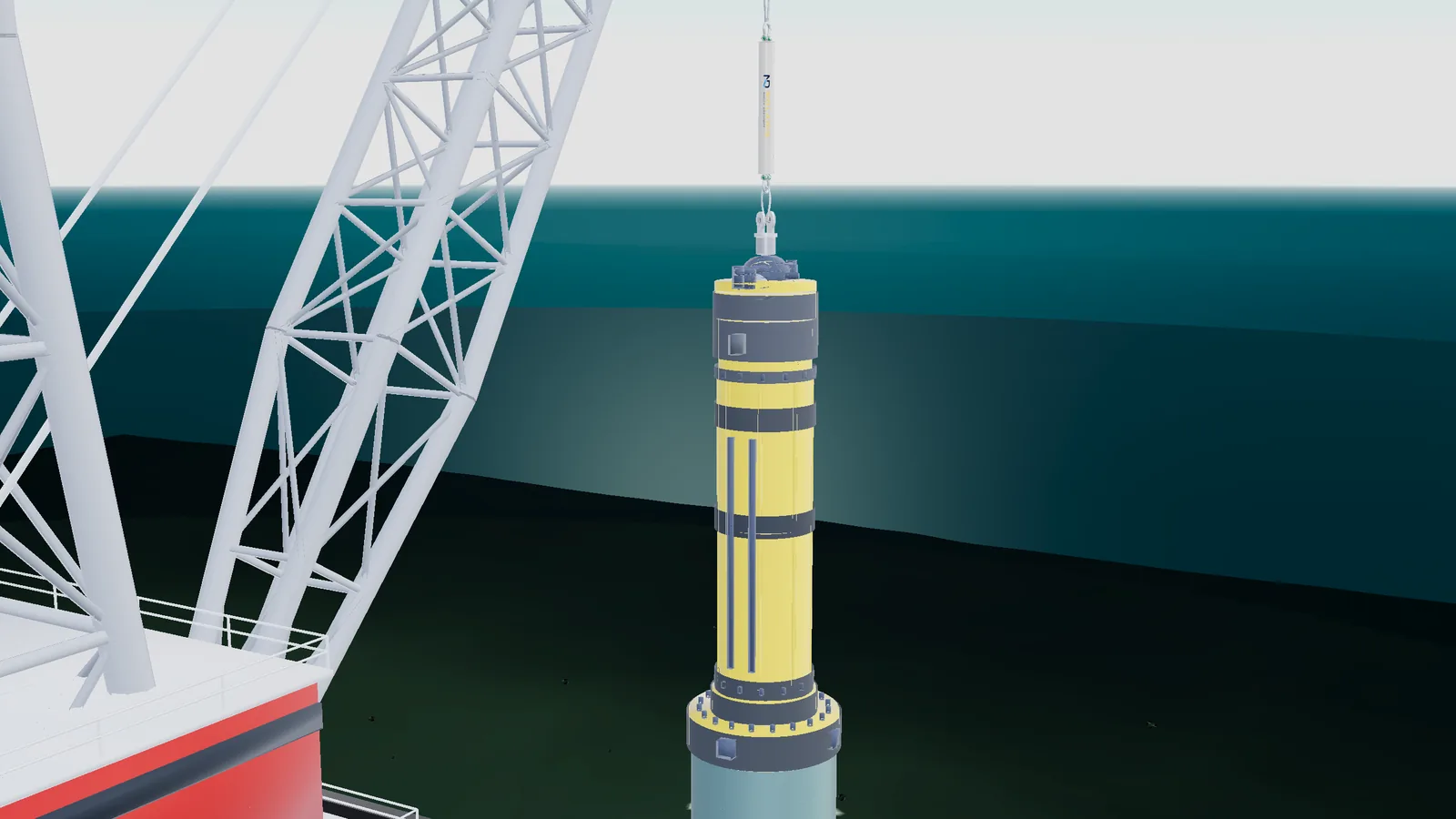
The event, fully specified
This is the full definition of the arrest — anything not listed is a model default. The two columns are generated from this one parameter set, and the run refuses to start unless the absorber’s presence is the only field that differs between them.
| Parameter | Value | Basis |
|---|---|---|
| Impact mass | 1,200 t pile + 300 t hammer, clamped · 1,500 t | Illustrative |
| Run-out velocity | 5.0 m/s at full static engagement | Model setup |
| Crane | 17,454 kN/m hoist · SWL 24,517 kN (2,500 t) | Illustrative |
| Hook and rigging | Hook 160 t · slings 49,763 / 46,653 kN/m | Model setup |
| Shock absorber | POLARIS 2,000 t · 6.0 m stroke | Product data |
| Valve and charge | Valve 18,000 kN · precharge 15,696 kN · gas 0.40 | ND engineering |
| Sea state | None — vessel muted, the arrest is isolated | Model setup |
| Counterfactual | Absorber replaced by a rigid link, nothing else changed | Model setup |
The same five seconds, twice
The trace is the primary result: one arrest, run once through a rigid link and once through the absorber. This is a single deterministic event — there is no random forcing, so every number is the maximum of its time series, not a statistical extreme.
Peak hook load, MN · crane SWL 24.5
Rigid, the arrest asks the crane for 154% of its safe working load. Through POLARIS it stays at 96.4%.
Hook DAF · static basis 16,553 kN
Reported, not gated — the governing limit for this event is the crane’s safe working load, drawn on the left.
| Metric | Rigid link | With POLARIS | Gate | Result |
|---|---|---|---|---|
| Peak hook load | 37,664 kN | 23,627 kN | ≤ 24,517 kN SWL | ✓ 96.4% |
| Hook DAF | 2.28 | 1.43 | — | reported |
| DAF below the absorber | 2.41 | 1.31 | — | reported |
| Full-slack events | 2 | 0 | 0 | ✓ |
| Stroke used | — | 4.98 m (83%) | < 6.0 m | ✓ |
| Annular oil floor | — | 6.2% | > 0 | ✓ |
Peaks are tracked on the 0.05 ms integration grid, not the 1 ms output samples — reading a sharp arrest off the plotted points under-reports it. The below-absorber DAF is reported against the payload’s own 14,710 kN static weight. POLARIS is sized by the energy budget of the arrest (mass, velocity and stroke) not by rated load alone.
Where this result stops being true
The envelope
- One pile, one crane, one valve setting. The result does not transfer to another pile mass, hammer, run-out velocity, crane stiffness or valve force. A different combination is a re-run, not an interpolation.
- No winch or operator response is modelled. After the first arrest the rigid-link trace is a free ring-down of the same chain — it shows what the load path does, not what a crew would do.
- Dry, deterministic, single event. No waves, no vessel motion, no ensemble. This study says nothing about behaviour in a seaway or about how often pile runs occur.
- The counterfactual is bounded, not exotic. The rigid-link peak of 37,664 kN sits between the two analytic estimates for this case (34,190 kN treating the crane as compliant, 44,759 kN treating it as rigid) because the crane spring partly responds within the arrest, which a closed form cannot represent.
Checked against an independent solver
The compensated column was cross-checked against OrcaFlex 11.3e on 17 July 2026, with the compensator reduced to a measured force law so the two solvers shared no code. Crane peak load agreed to +0.23%, crane DAF 1.4299 against CONSTELLATION’s 1.4266, peak stroke to −0.4%, and chain-force RMS to under 1% across the arrest.
The rigid-link counterfactual is Norwegian Dynamics’ own arrest mode, added 3 August 2026 so the “without” column could be computed rather than estimated. It reproduces the closed-form arrest where the closed form is exact, agrees with an independent stiff integrator on the full chain to under 0.5%, and lands between the two analytic bounds above.
What this document is not
- Not a certified analysis. It is a time-domain estimate from Norwegian Dynamics’ own model. It carries no marine warranty surveyor’s approval and cannot substitute for a project-specific analysis under DNV-ST-N001.
- Not a performance guarantee. Equipment supplied against a real piling campaign is sized from that campaign’s own masses, velocities and acceptance criteria.
Who checked what
The same pair, at the same values, is the pile-run worked example on the Dynamic Amplification Factor page — one reviewed set, quoted in both places, so the two can never drift apart.
Run record
Enough to re-run this case: the exact preset, version, definitions and solver settings behind every number above.
Run record — the published engineering basis
- Case
- CONSTELLATION preset factory:polaris_pile_run, scenario package DS10-PKG-POL-PIR, single velocity point at 5.0 m/s, valve force set to 18,000 kN (preset default 17,658 kN).
- Version and date
- CONSTELLATION v1.2.96, commit 29267cc. Run 3 August 2026. The compensated column is the case locked on 7 July 2026 and reproduces on this build to within 0.05 % on DAF.
- Operation phase
- Pile run — the drop-and-arrest event during driving (ND-DS-10 §10). Dry, in air, clear of the splash zone.
- DAF definition
- DAF = the maximum hook tension over the 5 s window divided by the static suspended weight at the hook: hook 160 t + POLARIS body 17.10 t + rod 10.85 t + payload 1,500 t = 1,687.95 t, i.e. 16,553 kN. The below-absorber DAF uses the payload’s own 14,710 kN: 1.31 with POLARIS, 2.41 without.
- Assessed load point
- The hook and crane connector, above the absorber. The rod force below the absorber is a separate channel and a different number.
- Vessel motion and sea state
- None, deliberately. A pile run is a sub-second shock event, so the host vessel is muted and no wave loading is applied — the case isolates the arrest. There is no Hs, Tp, spectrum or heading to quote, and this study says nothing about behaviour in a seaway.
- Duration, realisations, statistic
- 5.0 s window, output every 1 ms, integrated at 0.05 ms. One deterministic run per column — no seeds and no ensemble, because there is no random forcing to average over. The quoted peak is the maximum of the time series, and it is not comparable with an eight-seed envelope like the splash-zone study’s.
- Payload and load path
- 1,200 t pile plus a 300 t hammer, clamped, 1,500 t combined impact mass, run-out 5.0 m/s. Load path: crane 17,454.3 kN/m with 66.85 kN·s/m damping, hook 160 t, upper sling 49,762.8 kN/m, POLARIS body 17.10 t, rod 10.85 t, lower sling 46,652.7 kN/m, payload 1,500 t.
- Initial state and absorber settings
- 5.0 m/s downward at t = 0 from full static engagement — the assembly has hung on the unit before the run, so the gas is at operating pressure and both slings are taut at their static tensions. POLARIS 2,000 t / 6.0 m stroke, valve force 18,000 kN, gas precharge force 15,696 kN, gas fraction 0.40. The run uses 4.98 m of the 6.0 m stroke (83 %) and the annular oil chamber never empties (floor 6.2 %).
- Is the pair like for like?
- Yes, and it is checked rather than asserted. Both columns are generated from one parameter set; the script compares the two field by field and refuses to run unless the absorber flag is the only difference. Same masses, stiffnesses, damping, gravity, initial state and integration step.
- Governing limit
- Crane SWL 24,517 kN (2,500 t). With POLARIS the hook peaks at 23,627 kN, 96.4 % of it. Without, 37,664 kN — 154 % of crane SWL — and the line goes fully slack and re-tensions twice inside five seconds, which no peak-load figure on its own captures.
- Independent verification
- The compensated case was cross-checked against OrcaFlex 11.3e on 17 July 2026, with the compensator reduced to a measured force law: crane peak +0.23 %, crane DAF 1.4299 against 1.4266, peak stroke −0.4 %, chain-force RMS under 1 % across the arrest.
- What this is not
- Not transferable to another pile, hammer, crane or valve setting, and not a load chart. There is no winch or operator response in the model, so the uncompensated trace after the first arrest is a free ring-down of the same chain.
- Provenance note
- Until 3 August 2026 the “without” case could not be simulated: driving the gas volume to zero to emulate a locked cylinder sends the pressure term singular, so ND published an analytic DNV-RP-N103 snap estimate instead, whose value depended on which stiffness path was argued to govern — 34,190 kN treating the crane as compliant, 44,759 kN treating it as rigid. A rigid-link arrest mode was added to the simulator so the counterfactual is now computed rather than estimated. It lands at 35,387 kN on the payload side, between the two estimates and 21 % below the crane-rigid figure ND published in July.
Run your own case
Send the pile and hammer masses, the crane, and the run-out you need to protect against, and we will run the same arrest against it — including the configurations that fail.
Pile-run protection explains the physics behind this case · Shock absorption covers the energy budget · ← Back to the Knowledge Hub