Passive compensation through the splash zone: a 35 t GRP cover at modelled Hs 1.8 m
What a basic passive heave compensator does to the sling loads on a buoyant, low-mass payload crossing the water surface — and the sea state at which it stops working.
Screening result
Rigging the cover through the same sea on a RIGEL 75 t / 4.5 m unit takes the peak line load from 1 846 kN to 655 kN and shows no slack–snap cycle in any realisation. The four response screens (SWL, ND DAF, snap ratio and zero slack) pass in all eight realisations. The separate governing-stroke margin requires review: four of eight exceed 90%, reaching 98.4%, although no sampled end-stop contact is detected.
Stroke margin — review. The extend-end metric is 59.3–77.4%; the governing retract-end metric is 83.3–98.4%. Four of eight realisations exceed the separate ND <90% margin. Sampled end-stop contact remains zero in all eight.
What is being lifted, and through what
A 35 t glass-reinforced-plastic protection cover is lowered from a monohull construction vessel through the free surface. The cover is the awkward class of payload: light for its volume, so buoyancy and added mass change faster than the crane can respond, and it floats on entry rather than sinking cleanly away from the hook.
The comparison is like for like. Both columns below are the same payload, sea state, rigging and wave realisations. Only the compensator changes — present, or absent entirely.
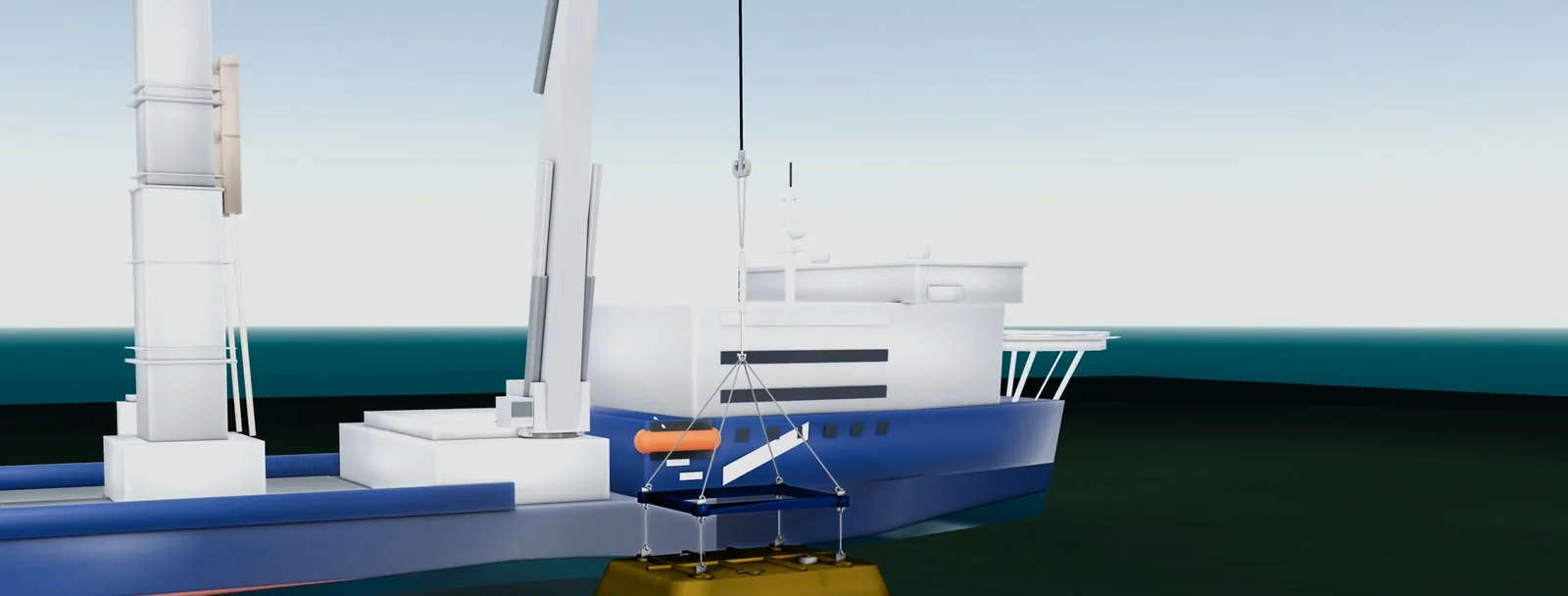
Published case definition
This table is the published case summary; the run record below adds the version-pinned inputs and exact outputs used for the comparison. It is not a complete input deck: the compensator’s internal gas charge is withheld, and unlisted software defaults remain in the cited model version and audit artefacts. Reproduction therefore depends on that run record, not on this table alone.
| Parameter | Value | Basis |
|---|---|---|
| Payload | 35 t GRP protection cover | Illustrative |
| Vessel | Monohull construction vessel | Project experience |
| Compensator | RIGEL 75 t · 4.5 m stroke | Product data |
| Compensator setup | Tuned to this payload and sea state; internal gas charge withheld | ND engineering |
| Sea state | Authored Hs 1.75 m; executed Hs 1.8 m · Tp 7.5 s | Model run · JONSWAP |
| Wave realisations | 8 seeds · 120 s each | Screening ensemble |
| Slam & added mass | Legacy H103 implementation; current public designation N103 | DNV-RP-N103 |
| DAF screen | ≤ 2.0 | ND screening reference |
| Snap-ratio screen | ≤ 0.90 | Study screen Project criteria govern |
| Stroke margin | Governing end < 90% | ND-DS-10 house margin |
Four response screens, plus one margin check
Every figure is the worst value of its own metric across the eight wave realisations — a per-metric envelope, not a single seed. No one realisation produces this combination. Eight realisations support this screening comparison; they do not establish convergence or design acceptance. The table keeps the four response screens separate from the additional governing-stroke margin check.
Payload DAF · ND screen 2.0
Green is the spread across all eight wave realisations, not one run. Every one clears the ND screening reference.
Peak line load, kN · SWL 736
Rigid, this lift asks the rigging for 2.5× its own safe working load. Compensated, it asks for 89%.
| Metric | Rigid | With RIGEL | Gate | Result |
|---|---|---|---|---|
| Peak line load | 1 846 kN | 655 kN · 89.0% SWL | SWL rating ≤ 736 kN | ✓ 8/8 |
| Payload DAF | 5.38 | 1.91 | ND screen ≤ 2.0 | ✓ 8/8 |
| Snap-load ratio | 1.00 | 0.36 | Study screen ≤ 0.90 | ✓ 8/8 |
| Slack-sling events | 8–11 | 0 | Study screen = 0 | ✓ 8/8 |
| Stroke utilisation | — | Extend 59.3–77.4%; governing 83.3–98.4% | ND governing-end margin < 90% | Review · 4/8 exceed |
A DAF of 1.91 clears Norwegian Dynamics’ 2.0 screening reference. The value 2.0 is not presented as a universal DNV acceptance limit; project-specific criteria govern. The separate governing-stroke margin prevents an all-pass conclusion.
Where this result stops being true
The envelope
- The published point executed at Hs 1.8 m. The authored 1.75 m value was rounded to one decimal before execution. At Hs 2.0 m no tested tuning clears the same four response screens. This discrete sweep does not establish an operating ceiling: eight realisations are screening-only, and the governing-stroke margin already requires review at 1.8 m.
- The tuning is load-specific. The charge used for this case was set for this payload and this sea state. The same unit under a heavier or denser load is tuned differently, and neither the settings nor the margins carry across.
- Buoyant payloads behave differently. A GRP cover floats on entry. A dense steel structure sinks away from the hook and produces a different slack mechanism entirely.
- Tp 7.5 s is a summer window. A winter spectrum nearer 11 s moves the rigging response and has to be re-run, not interpolated.
What this document is not
- Not a certified analysis. It is a time-domain estimate from Norwegian Dynamics’ own model. It carries no marine warranty surveyor’s approval and cannot substitute for a project-specific analysis under DNV-ST-N001.
- Not a performance guarantee. Equipment supplied against a real lift is sized from that lift’s own data and its own acceptance criteria.
Who checked what
The load figures are also quoted on the RIGEL product page. These are duplicated publications and must be updated together when the model basis changes.
Run record
The configuration table above summarizes the case; this record adds the published version, vessel and wave definitions, solver statistics, criterion ownership, and exact outputs. It records the issued run but is not a complete executable input deck because the internal gas charge is withheld.
Run record — the published engineering basis
- Case
- CONSTELLATION preset rigel_grp_splash_55t, scenario package DS10-PKG-SZ, with the comparison setting G/O 1.4 applied by paired_rigid_vs_rigel.py and paired_traces.py. The preset identifier is legacy: its 55t token is historical and describes neither the 35 t payload nor the modelled RIGEL 75 t unit. The tuning sweep is docs/audits/rigel-splash-2026-07-26/sweep_rigel_splash.py.
- Version and reproduction
- Issued figures produced 26–27 July 2026. The paired comparison was re-run on CONSTELLATION v1.2.96, commit 45998bc, on 3 August 2026, and reproduced every headline load figure exactly: 1,846 / 655 kN, DAF 5.38 / 1.91, snap ratio 0.36, slack 11 / 0. Reproduction also depends on the versioned software defaults and the withheld internal gas charge; this public record is not a complete executable input deck.
- Operation phase
- Splash-zone crossing — lowering through the water surface. No lift-off phase and no landing phase are modelled.
- DAF definition
- Payload DAF = the maximum sling-group tension over the run divided by the payload’s static weight in air, 35 t × 9.80665 m/s² = 343.2 kN. This is the study’s reported in-air basis. The peak is the maximum of the time series on the solver’s own grid, not of the plotted samples.
- Assessed load point
- The four-leg sling group immediately above the payload — not the hook and not the crane tip, which also carry the rigging and compensator weight and give different numbers.
- Vessel motion and sea state
- North Sea Giant: 25,397 t displacement, 161 × 30 m, draft 7.5 m, GMT 1.5 m, GML 80 m, radii of gyration 10.5 m and 38.2 m, heading 180° (stern seas; 0° is head seas in this model), six-degree-of-freedom response with the crane-tip RAO included. Irregular waves, JONSWAP, Tp 7.5 s, peak-enhancement factor auto-derived by the solver’s legacy H103-named routine, 200 spectral components, water depth 30 m. The preset authors Hs 1.75 m, but the model resolves design Hs to one decimal before execution. Every published figure therefore executes at Hs 1.8 m. The current public DNV designation is DNV-RP-N103.
- Duration, realisations, statistic
- 120 s per realisation, eight wave realisations (seeds 1–8) per column. Published values are a per-metric envelope — the worst value of each metric across the eight; no single realisation produces all worst numbers at once. Realisation 6 carries the governing peak line load and governing DAF in both columns. Eight seeds support a screening comparison, not convergence or formal design acceptance.
- Payload, rigging and equipment
- 35 t GRP protective cover, 15.0 × 12.0 × 3.0 m, slam area 180 m², displaced volume 10.73 m³, released 5 m above the surface toward a 15 m target depth. Rigging: four-leg wire-rope sling group at 60°, 3.0 m legs, group stiffness 84,823 kN/m; upper sling 5.0 m at 22,619 kN/m. Crane: wire luffing, 75 t at 30 m radius, hoist stiffness 13,622 kN/m, hook 7.5 t, 20 mm wire on four falls, lowering at 0.16 m/s. Compensator: RIGEL 75 t / 4.5 m stroke, passive with no EQ control, orifice 35 % extend and 70 % retract, pre-tension 35 t. The internal gas charge is set per lift and withheld from this public record (§02).
- Hydrodynamic basis
- Water entry on the relative motion between payload and wave kinematics: buoyancy from the instantaneous submerged volume, slamming on the 180 m² water-plane area, drag at Cd 1.3, hydrodynamic added mass at Ca 2.2, and the Froude–Krylov term. The issued model carries a legacy H103 implementation name; the current public DNV reference is DNV-RP-N103. Method alignment does not make DAF 2.0 a universal DNV acceptance limit.
- Criteria and ownership
- Four response screens are reported: peak sling load at or below the 736 kN unit SWL; payload DAF at or below the Norwegian Dynamics screening reference of 2.0; snap ratio at or below the study screen of 0.90; and zero slack-sling events. A fifth, separate ND-DS-10 governing-end stroke margin is < 90%. Project-specific acceptance criteria govern a real lift.
- Is the pair like for like?
- Yes. Both columns are the same preset on the same build, run over the same eight seeds; only the compensator’s presence in the load path differs. The plotted pair is realisation 6 on both sides, so the two traces see identical wave forcing.
- Exact values behind the rounded ones
- Peak sling load 1,846.0 kN rigid / 654.8 kN with RIGEL (both realisation 6). DAF across the eight seeds: 3.41–5.38 rigid, 1.15–1.91 with RIGEL. Snap ratio at or below 0.358 with RIGEL (8 of 8); 1.000 rigid. Slack-sling events: 8–11 per realisation rigid, 0 with RIGEL. Extend-end stroke utilisation is 59.3–77.4%; governing-end utilisation is 83.3–98.4%, governed by the retract end. Four of eight exceed the separate ND 90% margin; sampled end-stop contact is 0.0% in all eight.
- What this is not
- Not a design-basis DAF for any other lift, not a crane-capacity check, not formal design-acceptance evidence, and not an operating window. It is one screening case at one executed sea state.
- Where else these figures appear
- The RIGEL product page and the worked example on the Dynamic Amplification Factor page quote the load figures. They are duplicated publications and require synchronized review when the model basis changes.
Run your own case
Send the payload, rigging, water depth and the sea state you have to work in, and we will run the same four response screens plus the governing-stroke margin — including the checks it fails.
Splash-zone crossing explains the physics behind this case · ← Back to the Knowledge Hub