
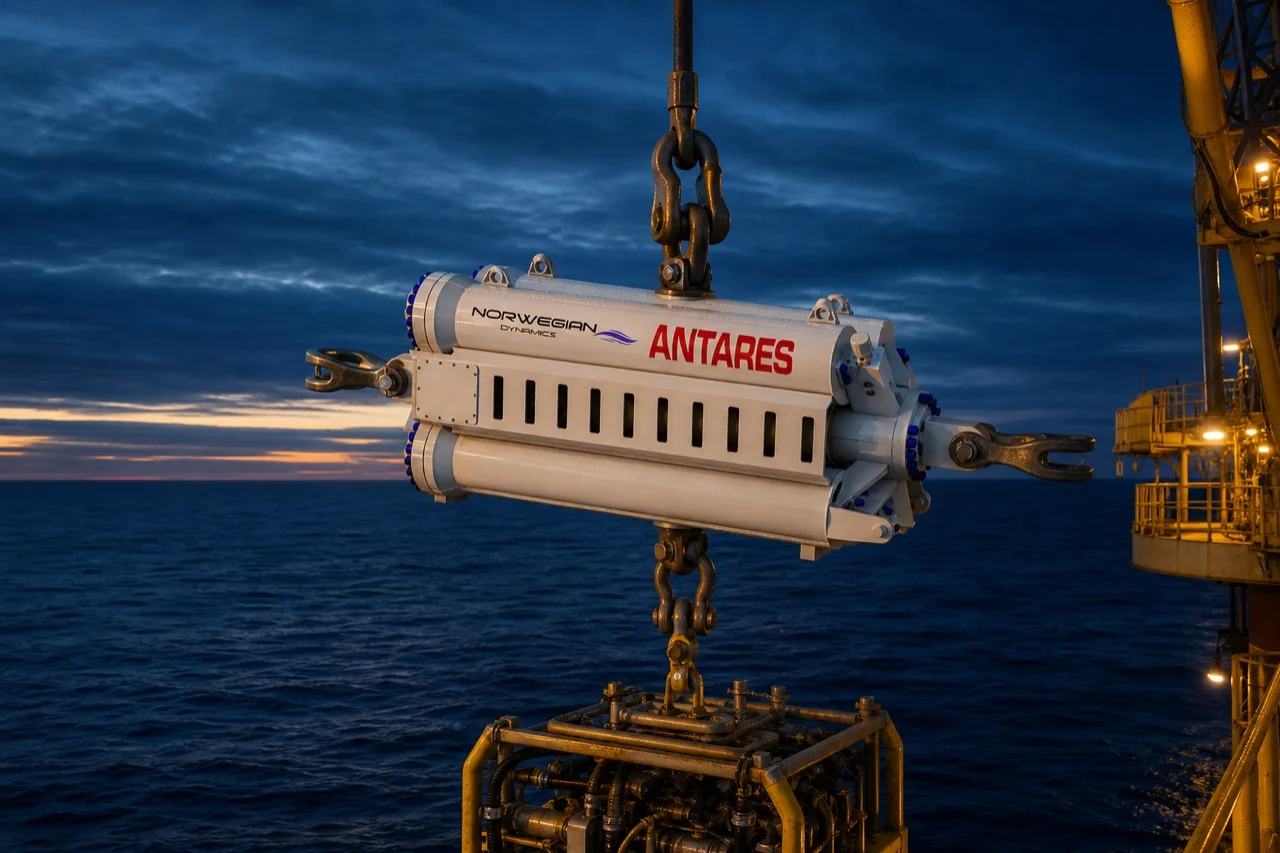
One passive unit, many operating points — retuned phase by phase, on battery.
Adaptive Passive Heave Compensation
By Peter Wang, COO · November 2025
Practical application: For practical application of this topic, see ANTARES Adaptive PHC and product / system design.
Adaptive passive heave compensation is an advanced form of passive heave compensation that can adjust its performance characteristics to suit different phases of an offshore lifting operation. Unlike basic PHC systems with fixed settings, adaptive compensators can switch between operating modes — such as locked, splash zone, and subsea — to optimize performance for each stage of the lift.
This makes adaptive PHC systems ideal for complex operations that involve multiple challenges, such as lifting through the splash zone followed by a precise subsea landing.
What's the difference between an adaptive PHC and a basic PHC?
Typically an adaptive PHC is a more expensive and higher performing compensator. The main differences are summed up in the below table:
| Feature | Basic PHC | Adaptive PHC |
|---|---|---|
| Cost | 1× | 2–3× |
| Gas to oil ratio | 3–4 | 8–16 |
| Stroke equilibrium control | ❌ | ✅ |
| Adjustable stiffness during use | ❌ | ✅ |
| Adjustable damping during use | ❌ | ✅ |
| Quick lifting | ❌ | ✅ |
| Temperature compensation | ❌ | ✅ |
| Weight compensation | ❌ | ✅ |
| Depth compensation | ❌ | ✅ |
| Battery operation | ❌ | ✅ |
| Data logging | ❌ | ✅ |
| Rod locking | ❌ | ✅ |
What does the adaptive PHC solve?
The adaptive PHC has many positive contributions:
- Filling and preparation of the PHC is done with software control that monitors that the filling is done according to the lifts parameters.
- Piston rod locking reduce required lifting height (the rod doesn’t extend when the payload is lifted).
- The weight of the payload is measured by the PHC (when it is attached) and gas pressures can be adjusted in case of an error (adjusted on the fly, the adaptive PHC doesn’t need to be brought back to deck).
- Splash zone settings are applied to ensure suitable dynamics during the crossing of the splash zone, which typically includes a higher stiffness setting, higher damping (extension and retraction) as well as equilibrium adjustments to compensate for buoyancy effects.
- When the adaptive PHC enters the seawater it will rapidly cool and hence the gas pressure will drop. This effect is compensated for using onboard high pressure gas which is injected to maintain pressure at the correct level.
- As the adaptive PHC is lower into deeper waters the external pressure will build up and cause significant forces that will tend to push the compensators piston rod inwards. This effect is compensated for by adjusting gas pressure down. Special techniques are used for extremely deep waters with lighter payloads. Contact us for more information about those.
- During landing or for avoiding resonance it is often required with low stiffness. The adaptive PHC has a low stiffness mode that increases performance in those scenarios (bigger gas volume is connected to the cylinder).
- The adaptive PHC can be used for shock absorption utilizing it’s adjustable damping which will limit extension damping and have higher retraction damping.
- The adaptive PHC can be used for quick lifting (multiple times is possible) which initially keeps tension below the weight of the payload and then quickly increases it causing retraction of the piston rod in a controlled manner.
- Data logging can be used to post process a lift to see stroke usage, DAF, landing speeds, etc.
The same hardware, mode by mode
| Mode | What the unit changes | When it is used |
|---|---|---|
| Locked | Piston rod held — no extension when the payload is lifted | Deck handling; reduces required lifting height |
| Splash zone | Higher stiffness, higher damping both ways, equilibrium offset for buoyancy | Crossing the surface |
| Subsea / depth | Gas pressure topped up as the unit cools, adjusted down as depth builds | Descent and deep water |
| Low stiffness | A larger gas volume connected to the cylinder | Landing and resonance avoidance |
| Quick lift | Tension held below payload weight, then raised rapidly — controlled rod retraction, repeatable | Lift-offs that must clear first time |
| Shock absorption | Low extension damping, high retraction damping | Snap and overload protection |
Every row is the same gas-spring hardware with different settings — applied on the fly, logged for post-lift review (stroke usage, DAF, landing speeds). This is the ANTARES operating envelope.
When should an adaptive PHC be used instead of a basic PHC?
- If the performance of a basic PHC is insufficient (for landing mostly).
- If the equilibrium position will drift too much with a basic PHC (can be offset partly by using longer stroke) for example due to buoyancy or water depth.
- If different settings are required to achieve required dynamics (different splash zone to subsea settings).
Adaptive passive HC — frequently asked
What is adaptive passive heave compensation?
How does it differ from a basic PHC?
Does it need external power?
What about cooling and depth effects?
When should I choose adaptive over basic?
Working on a lift that needs this?
ANTARES is our adaptive passive compensator — same hardware, multiple operating points. Tell us the lift data and we'll come back with sizing.
See it in action
ANTARES adaptive passive heave compensation — deck to seabed, simulated in CONSTELLATION