
Operations
Pile-Run Protection
Cap the shock when a driven pile breaks free and runs — protect the crane, the wire and the hammer, and keep the campaign on schedule.
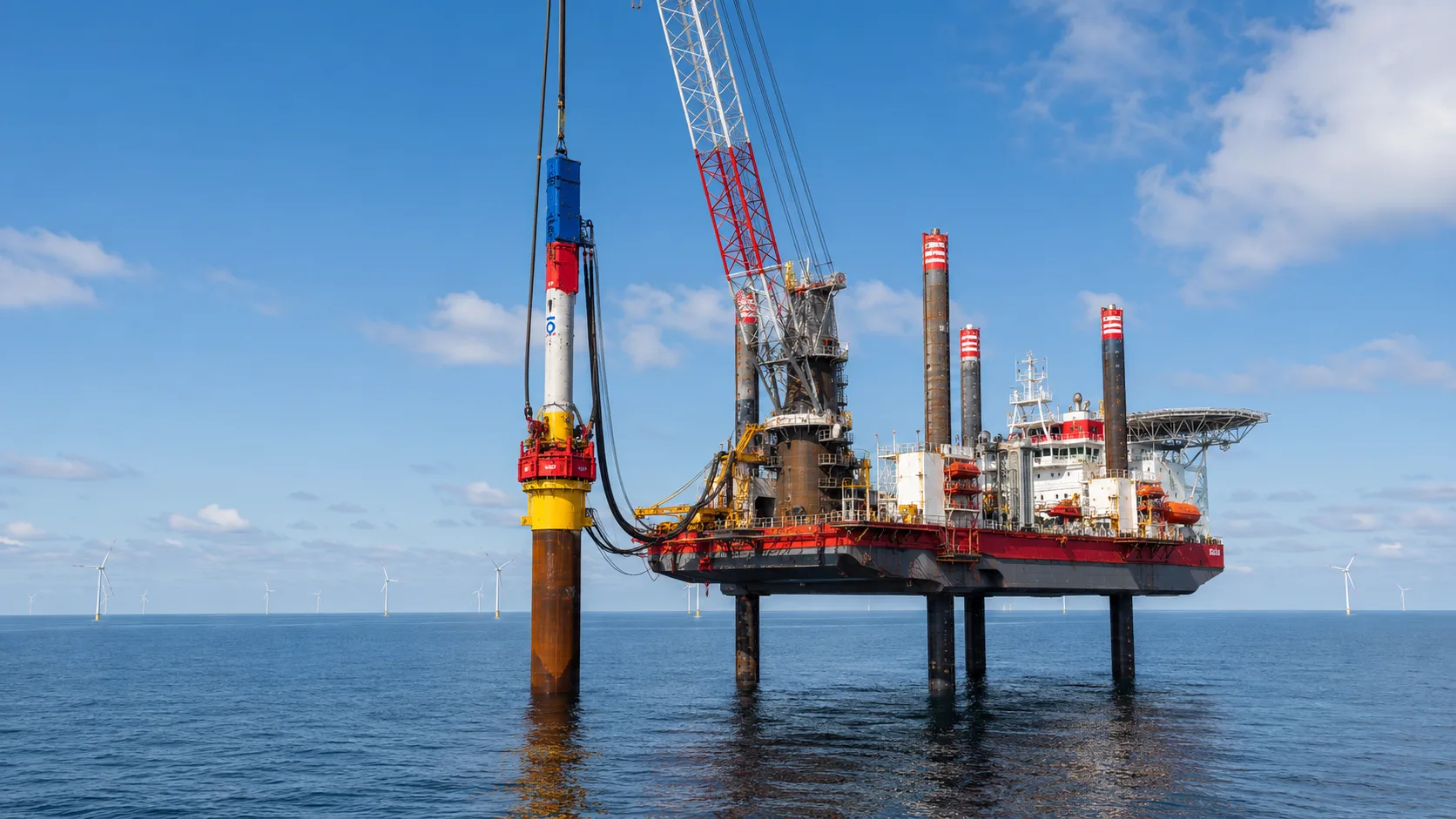
During offshore piling, a pile that punches through a soft soil layer can free-fall under its own weight. When the slack runs out the slings snap taut and the lift must arrest the running mass — a snap load that drives peak tension through the wire, hammer and crane far above the static hook load, with a dynamic amplification factor (DAF) that can exceed 3 in a clamped run, enough to overload the crane or part the rigging. POLARIS is a crane shock absorber that strokes the instant wire speed spikes, lengthening the deceleration (snubbing) time so the same arrested energy is dissipated at a far lower peak force — held to a preset ceiling and absorbed inline in the hydraulic cylinder. Lower peak loads keep the crane, wire and hammer inside their limits and the campaign on schedule.
What happens in a pile run
Break-through
A driven pile punches through a soft soil layer and its end-bearing resistance collapses, so the pile free-falls under its own weight.
Clamped or loose
What the lift has to catch depends on the connection. Clamped to the pile, the hammer runs with it and the absorber arrests the full hammer-and-pile assembly. Loose on the pile head, only the hammer stays on the line — the pile runs away on its own.
Shock path
When the slack runs out the slings snap taut and that mass is arrested through the wire, hammer frame and crane — a transient well above the static hook load that can overload the crane or part the rigging.
What we control
Cap the peak crane load
POLARIS holds the force transmitted to the wire, hammer and boom to a preset ceiling while the pile is brought to rest — cutting the dynamic amplification factor from 3.07 to 1.47 (about 75% off the peak) in the modelled run, instead of a rigid connection passing the full impact into the crane.
Absorb the run energy inline
Fitted inline between hook and load, POLARIS strokes on the sudden speed increase, dissipates the pile's kinetic energy in its hydraulic cylinder and damps the post-arrest oscillation in the wire and hammer. It is sized to the worst-credible run rather than the expected case.
Preserve the load chart
POLARIS is fully passive and self-contained — a single-cylinder unit with no external power, accumulators or HPU. It adds little rigging weight, so it barely eats into the crane's load chart, leaving capacity for the pile and hammer on high-capacity installation cranes.
Reset between piles
POLARIS is a single-shock device sized for one run at a time; it resets to ready between piles without coming back to deck, which suits the pile-by-pile rhythm of an installation campaign. It is not intended to soak up rapid repeated shocks within a single stroke.
A pile run, modelled
We size POLARIS against the worst-credible run. The case below is the clamped configuration — the hammer locked to the pile, so the absorber arrests the full 1,470 t hammer-and-pile assembly — on a 2,500 t crane from a 5 m/s run (18,375 kJ), modelled in CONSTELLATION, our in-house lift-dynamics simulator.
| Metric | Rigid connection | With POLARIS |
|---|---|---|
| Peak hook load | 44,890 kN | 21,886 kN |
| Dynamic amplification factor | 3.07 | 1.47 |
| Crane utilisation (2,500 t) | 183% of SWL | 89% of SWL |
| Shock above static load | +30,469 kN | +7,465 kN (-75%) |
| Compensator stroke used | n/a | 4.77 m of 6.0 m |
Modelled in CONSTELLATION, Norwegian Dynamics' in-house lift-dynamics simulator: it builds the complete load path — crane, reeving, rigging, compensator and payload — as one coupled time-domain model and solves the arrest for peak hook load, dynamic amplification, stroke and absorbed energy. The case shown is one arrangement; every pile run is sized on its own pile mass, drop and soil profile.
How we size a POLARIS unit
Sized to the heaviest credible run
We size to the clamped case — the absorber arresting the hammer and pile together — so the capped peak stays inside the crane certificate and load chart, and a lighter loose run, where only the hammer is on the line, sits well within it.
One shock at a time
POLARIS is a single-shock absorber: it strokes on one run, then resets to ready between piles without returning to deck. It is not intended to soak up rapid repeated shocks within a stroke.
Stroke held in reserve
In the modelled 5 m/s run POLARIS used 4.77 m of its 6.0 m stroke — the gas spring and bleed valve absorb the energy progressively, holding the force ceiling while keeping travel in reserve for an even harder run.
Checked against the crane
Peak hook load is verified against the crane derated capacity, the marine-operations standard DNV-ST-N001 and the modelling guidance DNV-RP-N103, keeping utilisation off the limit so a run does not overload the crane or stand the campaign down.
Matched to your run, not a catalogue
POLARIS is specified per case across the offshore-piling range — SWL from 75 t to 4,000 t and strokes to 8 m — so the unit suits your worst-credible run rather than a fixed product.
Choose the right compensator
The engineering behind it
For the full method and worked examples, see the engineering guide — forces are sized to DNV-RP-N103 and checked against the crane’s derated capacity.
Size a POLARIS unit for your worst-credible pile run
Send the crane SWL and certificate, the pile and hammer mass, the worst-credible run and the soil profile. We’ll come back with a recommended POLARIS size, the capped peak hook load and the next engineering step.