
Operations
Quick Lift
Snatch the payload off a heaving barge before the next wave can slam it back — the ANTARES quick-lift clears the deck fast, where a conventional crane is left waiting on the sea.
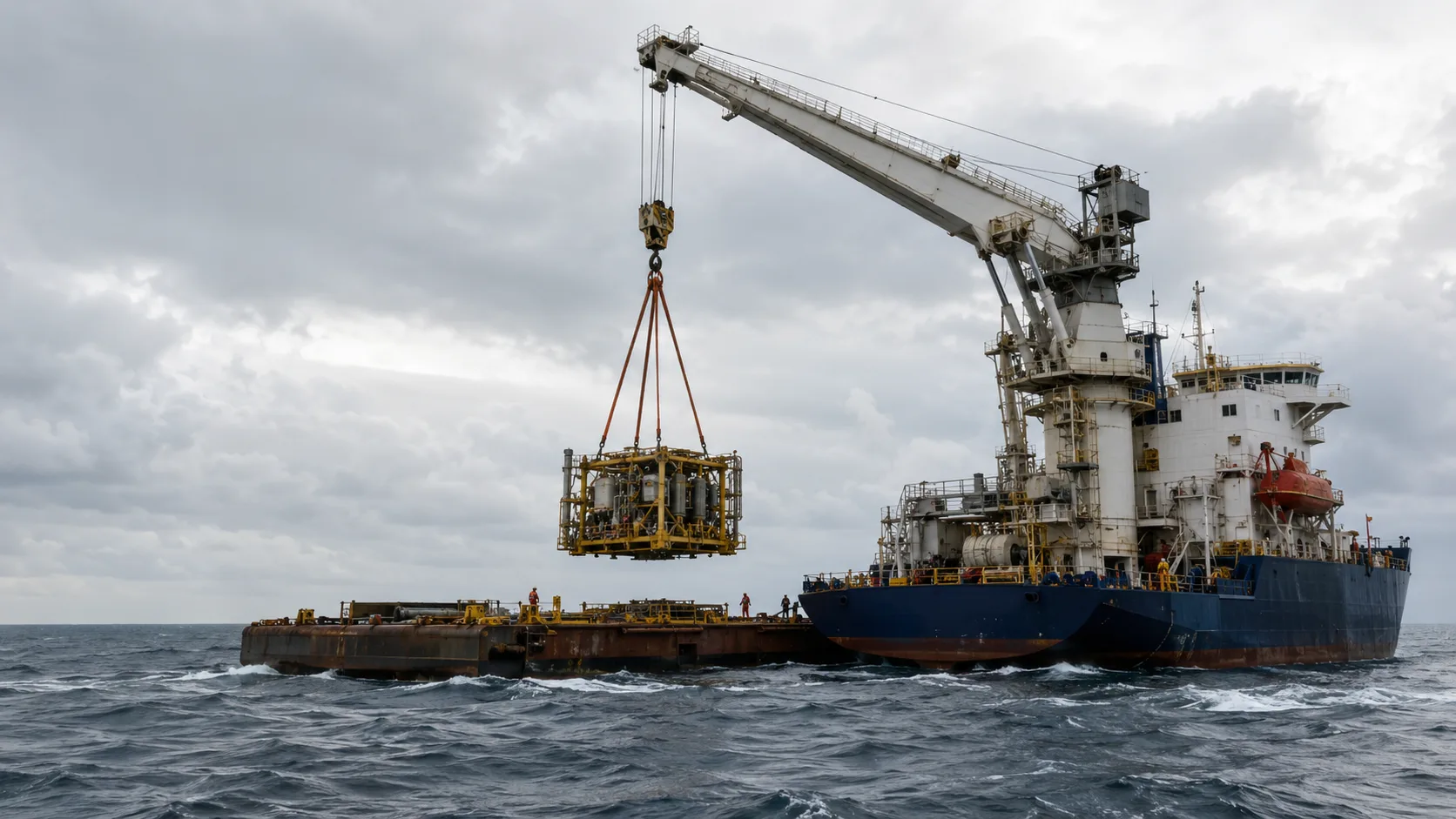
Lifting a heavy load off a transport barge or supply vessel is one of the most exposed moments offshore. The deck keeps heaving on the swell, and a conventional crane can only hoist so fast — so the load lingers just above the deck through several wave cycles, and a following crest can bring the barge back up into it. Keeping clear of that re-contact — the load lifting clear, then a wave bringing the deck back up into it — is the governing safety criterion for a barge lift-off under DNV-RP-H103 §9.5. The ANTARES quick-lift removes the wait: it valves in a pre-charged gas tank that steps up the rod force and snatches the payload vertically clear of the deck — faster than the sea can follow — then holds it on adaptive passive heave compensation through the rest of the lift. Designed to DNV-RP-H103 and DNV-ST-N001. In one line: get the load clear before the wave returns, then keep the line steady.
What happens in a barge lift-off
Take the load
The crane takes the weight off the barge; the slings come tight and the payload is ready to leave the deck.
The deck keeps moving
The barge rides the swell, rising and falling under the payload while it hangs close to the deck.
Clear, or re-contact
The load has to rise clear of the heave envelope before a following crest brings the deck back up. A slow lift can be caught and slammed; the quick-lift snatches clear first.
What we control
Fire the quick-lift tank
ANTARES valves in a pre-charged gas tank the instant the lift is triggered, stepping the rod force up so the cylinder extends fast and lifts the payload vertically off the deck — a controlled snatch, not a winch crawl.
Clear before the next wave
The snatch carries the load up through the heave envelope quicker than the deck can rise again — so the lift clears cleanly wherever the next wave falls, instead of gambling on the timing.
Keep the slam off the rigging
Clearing fast keeps the deck slam off the rigging and limits the snap load — the spike when a slack line goes suddenly taut — so the load rides at a lower dynamic factor than a rigid lift, gentler on the crane, the wire and the payload.
Then hold it on adaptive passive compensation
Once the load is clear, ANTARES reverts to adaptive passive compensation, holding line tension steady through the rest of the lift to the seabed or the deck.
A barge lift-off, modelled
We model the lift-off in CONSTELLATION as a Monte Carlo: the same 250 t payload taken off a transport barge in Hs 2.16 m and Tp 5.5 s, across 120 sea states, lifting at the same favourable moment each time. A conventional crane — a rigid line, no compensation, hoisting across the realistic heavy-lift range of 1 to 20 m/min (0.02 to 0.33 m/s; the DNV §9.5 lower limit is about 0.1 m/s) — is set against the ANTARES quick-lift snatch.
| Crane hoist speed | Conventional crane | ANTARES quick-lift |
|---|---|---|
| 1–3 m/min — heaviest lifts | 100% re-contact | 0% |
| 5 m/min | 86% | 0% |
| 10 m/min — DNV §9.5 hoist floor | 52% | 0% |
| 20 m/min — fast, lighter loads | 15% | 0% |
In that modelled quick-lift the 250 t payload leaves the deck and rises clear, at a payload dynamic amplification factor of 1.27 and a peak sling load of 3,118 kN — inside the rigging and crane limits, on 64% of the ANTARES stroke.
Modelled in CONSTELLATION, Norwegian Dynamics' in-house lift-dynamics simulator: it builds the complete load path — crane, vessel, rigging, compensator and payload — as one coupled time-domain model and solves the lift-off for deck clearance, re-contact, dynamic amplification and stroke. Deck re-contact is evaluated as DNV-RP-H103 §9.5 defines it — the governing criterion for a barge lift-off. The case shown is one sea state; every lift is sized on its own payload, vessel and sea.
How we size an ANTARES quick-lift
Sized to clear the heave envelope
The gas tank and valve are sized so the snatch lifts the payload past the deck-clearance margin within the time the sea allows, for your payload mass and design sea state.
Adaptive passive after the snatch
Once the load is clear, ANTARES holds it on tuned gas-spring stiffness and damping for the rest of the lift, keeping line tension steady at a low dynamic factor.
Re-contact checked to DNV
Deck clearance and re-contact are verified to DNV-RP-H103 §9.5, dynamic loads to DNV-RP-N103, and peak loads against the crane derated capacity.
Matched to your lift
The quick-lift is specified per case across the ANTARES range — to your payload, crane hoist speed, vessel and design sea state — rather than a fixed catalogue unit.
Choose the right compensator
The engineering behind it
For the full method and worked examples, see the engineering guide — forces are sized to DNV-RP-N103 and checked against the crane’s derated capacity.
Planning a lift-off from a barge or supply vessel?
Send the payload mass and dimensions, the crane and its hoist speed, the barge or supply-vessel deck and the design sea state. We’ll come back with a recommended ANTARES quick-lift configuration, the modelled deck clearance and lift-off time, and the next engineering step.