
Operations
Splash-Zone Crossing
Control the slam peak and the heave through the splash zone, so the crossing happens inside a wider, safer weather window.
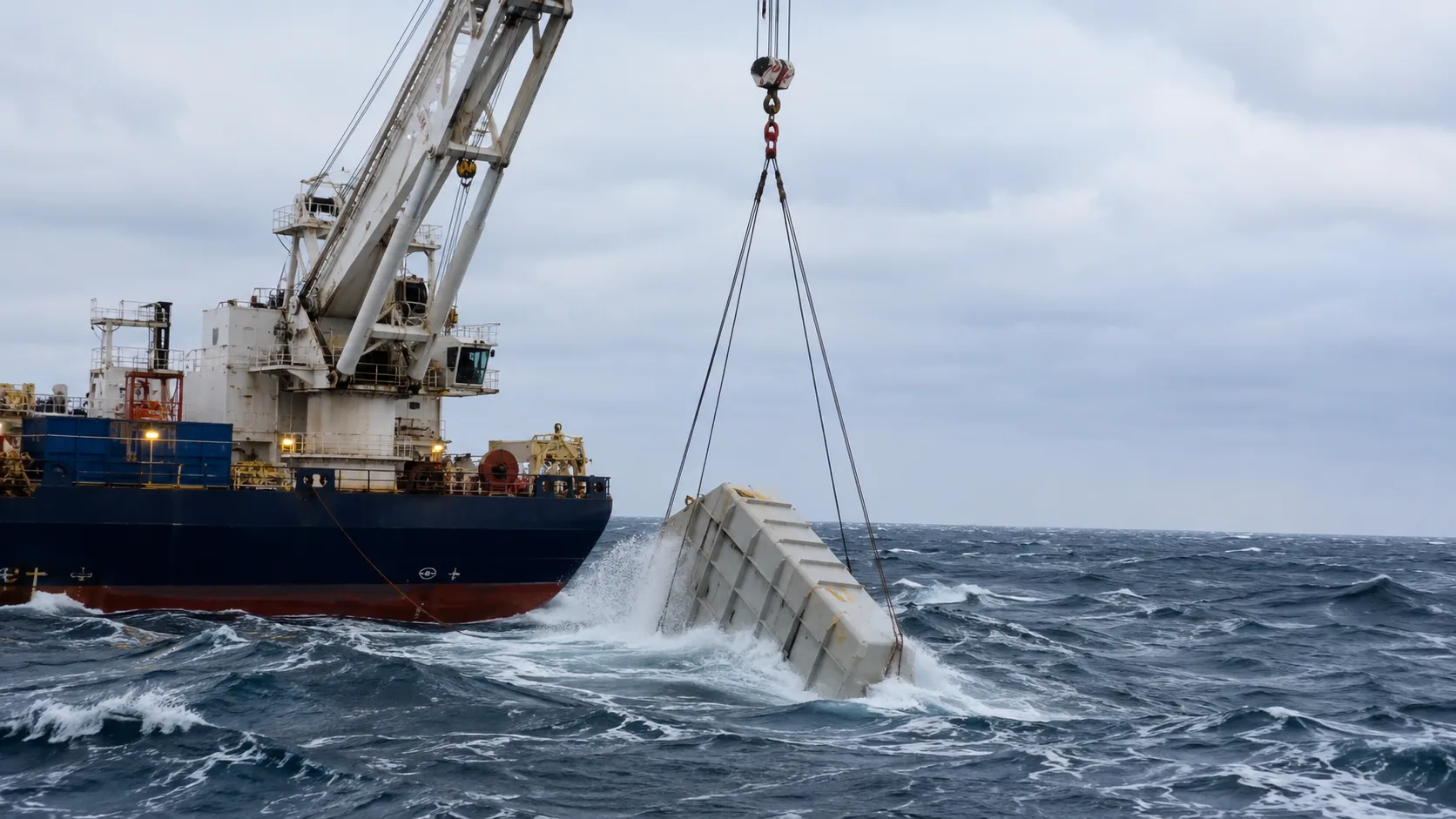
Crossing the splash zone is the most load-critical moment of a subsea lift. As the object passes the surface, wave kinematics and slamming drive a sharp peak load, while vessel heave keeps cycling tension in the rigging for as long as the load hangs near the water line. Norwegian Dynamics addresses both: POLARIS absorbs the single slam or snap peak at the surface, and a passive heave compensator keeps line tension steady through the wave cycle. The result is lower dynamic amplification factors, fewer overload events, and a measurably wider weather window for the operation. Design basis follows DNV-RP-N103 and DNV-ST-0378.
What we control
Cutting the slam peak
POLARIS, a pilot-controlled crane shock absorber, takes the single slam or snap load as the object breaks the surface, capping the peak before it reaches the crane and rigging. It is sized for the one-off event at the water line, not for continuous cycling.
Steadying heave tension
Through the wave cycle, a passive heave compensator decouples the load from vessel motion to hold line tension steady. RIGEL is the default single-cylinder PHC; CYGNUS carries heavier subsea lifts at lower weight.
Presetting for the sea state
Where the lift needs tuning to the forecast wave period and load, ANTARES adaptive passive compensation lets the gas-spring and damping be preset before the crossing, keeping response matched as the object enters the water.
Widening the weather window
Lowering the dynamic amplification factor at the surface raises the sea state at which the crossing stays inside limits, de-risking the lift and reducing standby. POLARIS handles the discrete slam or snap peak; the heave compensator handles the cyclic tension through the wave cycle.
Choose the right compensator
The engineering behind it
For the full method and worked examples, see the engineering guide — forces are sized to DNV-RP-N103 and checked against the crane’s derated capacity.
Plan a safer splash-zone crossing with the right compensation
Send SWL, stroke, sea state, payload and operation sequence. We’ll come back with a recommended compensator, an operating-window view and the next engineering step.