
Passive · Adaptive · Active
Heave Compensation Systems
Heave compensation decouples a suspended load from the vertical motion of the vessel carrying it. A compensator in the lift line takes up the vessel’s heave in a hydraulic cylinder working against a gas spring, so the load moves less and the wire tension stays under control. Passive, adaptive passive and active systems do it in different ways; compare them below.
Send your lift caseCompare the approaches ↓
Start with your load, lift sequence and available vessel data. CONSTELLATION supports project-specific lift studies and equipment assessment.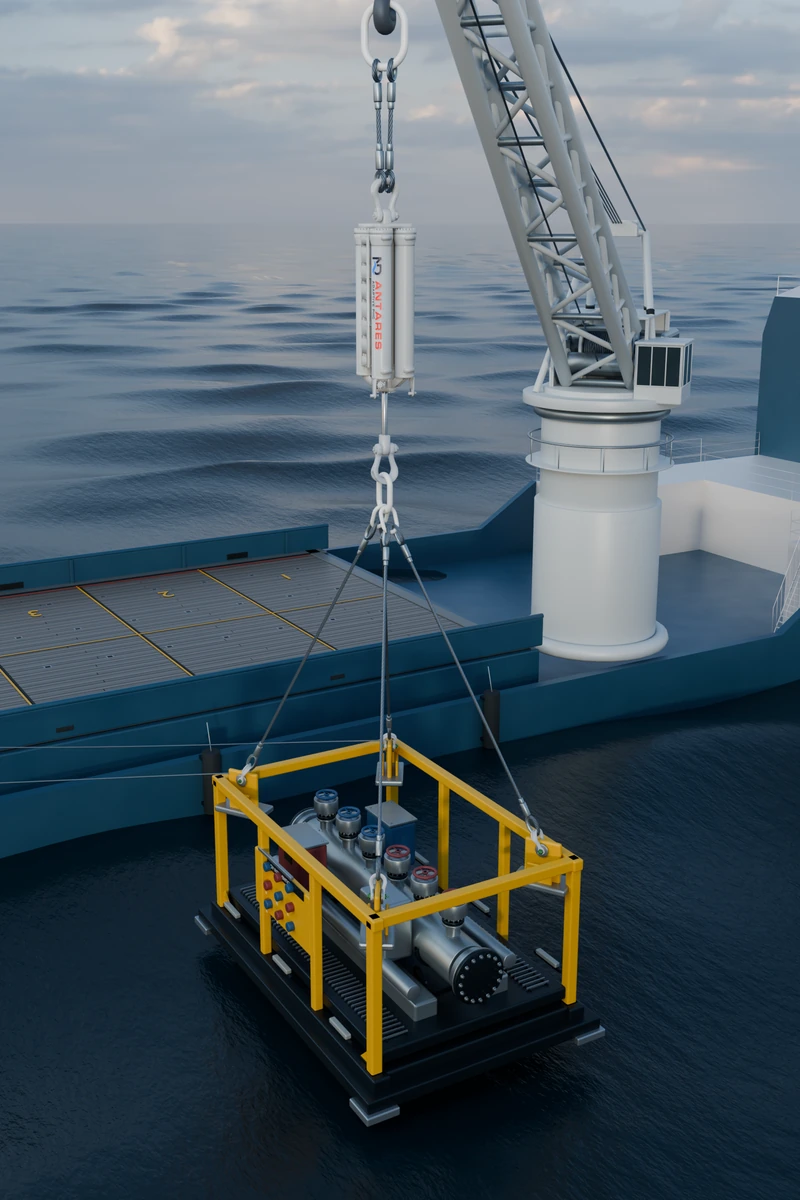
Selection
Choose the control approach. Then size the system.
Start with the lift sequence and the control it requires. Capacity, stroke and suitability are established for the selected configuration and project.
Passive
A gas-spring system configured for the planned load and operating conditions.


Power and control details
- Power: no external power, sealed gas spring and hydraulic damping; CYGNUS carries a small battery, no umbilical
- Complexity: lowest, no operator during the lift
- Tuning: damping and stiffness are set for the analysed load and motion conditions.
- Typical use: splash-zone crossing, subsea lift & landing, retrieval
- Products: RIGEL (55–1,000 t), CYGNUS (12.5–10,000 t)
Adaptive passive
Passive compensation with control settings and operating modes that can change through the lift.

Power and control details
- Power: battery (medium) for the control system, no umbilical, the compensation itself is unpowered
- Complexity: moderate: automatic damping control, battery, no umbilical
- Wave sensitivity: automatic damping control re-tunes through the lift
- Typical use: multi-step lifts, locked, splash-zone, subsea and soft-landing modes in one deployment
- Products: ANTARES (30–4,000 t)
Active
Active cylinder control using motion feedback for operations that require it.

Power and control details
- Power: battery operated (large battery), no umbilical
- Complexity: highest, MRU-driven closed-loop feedback
- Control: motion feedback drives active cylinder response within the system’s assessed envelope.
- Typical use: precision landings, topside motion control, long-duration operations
- Products: VEGA-T topside / VEGA-S subsea (75–2,500 t, in development)
Performance depends on the lift and the selected configuration. Compare peak load, minimum tension and stroke in matched project cases; a general efficiency percentage cannot establish suitability. Read the full comparison →
Bring the lift sequence, not just the load rating.
These inputs help define the study and equipment scope. They are a starting brief, rather than a complete design basis.
- Load & rigging
- Payload, rigging arrangement and available lifting data.
- Operation
- Lift-off, splash zone, lowering, landing or recovery.
- Motion & environment
- Vessel, water depth, metocean and motion data available.
- Constraints
- Landing requirements, space, duty and project acceptance basis.
Compare heave compensators: capacity, stroke and control
| System | Type | Capacity (SWL) | Stroke | Control | Status & documents | Best for |
|---|---|---|---|---|---|---|
| Passive · basic | 55–1,000 t | 1.0–6.0 m | Manual damping & stiffness · set on deck | Designed & classed to DNV-ST-0378 · DNV Type Approval in progress | Predictable splash-zone crossings and standard subsea lifts |
| Passive · wide range | 12.5–10,000 t | 1.0–6.0 m | Manual damping · self-centering spring | Designed & classed to DNV-ST-0378 | Full-range passive lifts: 12.5 t heave compensation cylinders to 10,000 t heavy-lift units |
| Adaptive passive | 30–4,000 t | 2.5–8.0 m | Automatic damping · self-centering spring · quick lift | Designed & classed to DNV-ST-0378 | Complicated, multi-step subsea lifts |
| Active · in development | 75–2,500 t | 2.5–6.0 m | Automatic damping · active cylinder control · self-centering spring | In development | Topside and subsea lifts needing the tightest motion control |
Swipe sideways to compare stroke, control, certification and best-for →
Published product ranges are a starting point for selection. Confirm the datasheet, configuration, availability and required certification deliverables for the proposed unit. A Type Approval does not replace mandatory product certification. Read the certification guide →
Crane shock absorption (POLARIS) and tensioning (SIRIUS) are covered on their own pages: POLARIS crane shock absorber · SIRIUS tensioner.
The range
Four heave compensation systems, one engineering basis
Every Norwegian Dynamics compensator (passive, adaptive or active) is sized from the same first principles and screened against the same acceptance gates before steel is cut.
Passive heave compensators
no external power, no umbilical: the workhorsesA single-cylinder passive compensator with manually adjustable damping and stiffness, set on deck to the lift. No electronics offshore. Designed and classed to DNV-ST-0378, with DNV Type Approval in progress.
- SWL
- 55–1,000 t
- Stroke
- 1.0–6.0 m
- Depth rating
- subsea, 3,000 m
- Control
- manual damping & stiffness · set on deck
- Power
- none · no electronics offshore
A passive heave compensator with manually set damping and a self-centering spring: the full-range passive line, from 12.5 t up to 10,000 t for monopile, jacket and salvage work. First deliveries 2026, configurations from USD 15,000.
- SWL
- 12.5–10,000 t
- Stroke
- 1.0–6.0 m
- Control
- manual damping · self-centering spring
- Power
- battery (small) · no umbilical
Adaptive passive
passive physics, automatic damping controlAn adaptive compensator with automatic damping control and quick-lift ability, switching operation mode through the lift: locked for the deck lift, stiff through the splash zone, soft for the subsea run, soft-landing for set-down. One unit covers the whole operation sequence without re-rigging, with modes and control settings assessed for the project.
- SWL
- 30–4,000 t
- Stroke
- 2.5–8.0 m
- Control
- automatic damping · self-centering spring · quick lift
- Power
- battery (medium) · no umbilical
- Modes
- locked · splash-zone · subsea · soft-landing
Active heave compensation
closed-loop control, MRU-drivenAn inline, self-contained active heave compensation system: active cylinder control driven by real-time motion reference unit feedback, layered on automatic damping control and a self-centering spring. Battery operated, no umbilical. VEGA-T executes motion control topside; VEGA-S holds and lands loads at depth when passive compensation cannot keep the set-down inside the window. In development: engineering data available on request.
- SWL
- 75–2,500 t
- Stroke
- 2.5–6.0 m
- Control
- automatic damping · active cylinder control · self-centering spring
- Power
- battery (large) · no umbilical
- Variants
- VEGA-T topside · VEGA-S subsea
Sizing & engineering
Sized to DNV-RP-N202, screened in CONSTELLATION
A compensator is only as good as its sizing. Norwegian Dynamics sizes gas volume, damping and stroke from first principles to DNV-RP-N202, the recommended practice written specifically for heave compensating systems. Hydrodynamic load inputs (slamming, added mass, snap criteria) are modelled per DNV-RP-N103, and operational acceptance follows DNV-ST-N001.
Then the whole lift is screened, not just the unit: CONSTELLATION runs the operation deck-to-seabed in the time domain, across the full Hs×Tp sea-state range, checking every acceptance gate, splash DAF, slack-sling, landing DAF, touch-down velocity, stroke utilisation. You see the operating window before you mobilise, and the compensator is sized to the window you need.
Workable sea states, screened gate-by-gate to DNV-RP-N103 and the Norwegian Dynamics design standard ND-DS-10: a representative deck-to-seabed installation on an ANTARES 250 t adaptive compensator, modelled in CONSTELLATION. Project screenings use your metocean and vessel.
The physics input
Vessel motions: what a heave compensator absorbs
A floating vessel moves in six degrees of freedom at once: surge, sway and heave (translations), roll, pitch and yaw (rotations). Only heave runs straight down the crane wire, but roll and pitch feed it: with the crane away from the vessel’s centre of flotation, the lever arm turns rotations into extra vertical motion at the tip, so effective crane-tip heave can be significantly larger than the vessel’s pure heave.
| DOF | Motion | Lifting relevance |
|---|---|---|
| Surge | Fore–aft translation | Positioning, minor for hook load |
| Sway | Side-to-side translation | Positioning, pendulation input |
| Heave | Vertical translation | Direct crane-tip motion: the compensator’s target |
| Roll | Rotation, longitudinal axis | Adds crane-tip heave via the lever arm |
| Pitch | Rotation, transverse axis | Adds crane-tip heave via the lever arm |
| Yaw | Rotation, vertical axis | Heading: minor for vertical motion |
How much a given hull moves in a given sea is set by its Response Amplitude Operators (RAOs): the vessel’s motion per unit wave amplitude, by frequency and heading, unique to each hull form and loading condition. RAOs combined with the wave spectrum give the crane-tip motion that sizes the compensator: stroke must exceed the peak-to-peak crane-tip heave with margin, maximum piston velocity follows from amplitude and wave period, and the natural period is tuned clear of the dominant wave periods.
| Vessel type | Motion character | Where it fits |
|---|---|---|
| Semi-submersible | Lowest heave RAOs: small waterplane area | Heavy lifts, demanding operations |
| Monohull CSV | Moderate heave, roll and pitch | The workhorse of subsea installation |
| Jack-up | Zero heave jacked up; motion in transit | Shallow water, repeat operations |
| Barge | Highest amplitudes, roll especially | Heavy-lift cranes in calm windows |
Semi-submersibles carry the demanding heavy lifts for a reason: small waterplane area, lowest heave. The wave side of the story is on the waves page.
The physics
How heave compensation works
Heave compensation introduces compliance between the moving crane-side connection and the suspended load. The aim is to reduce transmitted motion and dynamic loading within the system’s assessed operating envelope.
In a gas-spring compensator, compressed nitrogen provides the spring force through a hydraulic cylinder. The load, gas volume and pressure affect the system’s stiffness and response.
Hydraulic damping resists relative motion and dissipates energy. Stiffness, damping and motion frequency must be assessed together with available stroke, end-stop loads and minimum tension. Compensation reduces response; it does not make the load motionless under every condition.
All three families on this page (passive, adaptive passive and active) build on this same spring-and-damper physics; they differ in how the spring and damping are controlled, compared line by line in the selection guide.
- Gas springSupports the suspended load through the cylinder.
- Hydraulic dampingResists relative motion and dissipates energy.
- Available travelStroke, end stops and minimum tension are project checks.
See it in action
The compensators at work, simulated in CONSTELLATION
Each clip is a CONSTELLATION simulation of a real lift case: the same time-domain model behind the screening above. Watch the compensator hold line tension through the sea state.
Applications
Where heave compensation earns its keep
Subsea lifts
Drag, added mass and snap criteria from surface to seabed: compensation keeps wire tension positive throughout the screened operating window.
Subsea lifting loads →Splash-zone crossing
Slamming and buoyancy transients drive the DAF spike that sets most weather windows. Passive stroke absorbs it.
Splash-zone crossing loads →Offshore wind
Monopile, transition-piece and nacelle lifts on compressed installation schedules: heavy capacity meets tight tolerances.
Heave compensation for offshore wind →Decommissioning
Weight uncertainty and corroded lift points eat DAF margin: compensation puts it back.
Decommissioning lifts →Working one of these lifts now? Send your lift case: we screen it in CONSTELLATION against your metocean and vessel.
Proof
Delivered hardware. Project-specific evidence.
- Delivered: a 150 t / 4.5 m adaptive passive heave compensator for an international offshore EPC contractor.
- Delivered: a 3 t / 1.25 m unit in the UK, six weeks from order to handover.
- Certification: request the current certificates, scope, limitations and Type Approval status for the proposed unit. ISO 9001:2015 quality management.
- Performance: assess the lift response, minimum tension and stroke in the project model.
Operational support
Supported through the campaign, not just the sale
The engineers who size your compensator commission it, support it offshore and support its recertification: one team from lift data to demobilisation.
FAQ
Heave compensator questions, answered
What is a heave compensator?
A hydraulic-pneumatic unit installed between the crane hook and the payload (or integrated in the lifting arrangement) that absorbs the relative vertical motion between vessel and load. It keeps wire tension inside acceptance limits, cuts the dynamic amplification factor and prevents slack-wire and snap-load events inside the screened operating window. For the physics, see how heave compensation works.
Passive, adaptive or active, which do I need?
Passive (RIGEL, CYGNUS) for most splash-zone and subsea work with no external power; adaptive passive (ANTARES) when one deployment must cover locked, splash-zone, subsea and soft-landing phases; active (VEGA, in development) when the operation justifies MRU-driven active cylinder control: battery operated, no umbilical. The decision guide above compares them line by line.
What size heave compensator does my lift need?
Capacity follows the payload SWL; stroke and damping follow the sea state (Hs, Tp), water depth and operation sequence. We size to DNV-RP-N202 and confirm the choice by screening the whole lift in CONSTELLATION. Send your lift case: SWL, depth and expected Hs/Tp are enough to start.
Which DNV standards apply to heave compensators?
DNV-RP-N202 (heave compensating systems) is the governing recommended practice; units are designed to DNV-ST-0378 (offshore lifting appliances); load modelling follows DNV-RP-N103 and operational acceptance DNV-ST-N001. Our DNV standards guide maps them all.
Can a heave compensator extend my weather window?
Yes: by cutting the DAF and keeping rigging tension positive, a correctly sized unit raises the workable significant wave height and recovers capacity lost to DAF derating on the crane load chart. See weather windows for offshore lifting, and quantify it for your lift with a CONSTELLATION screening.
What is the typical delivery time for a heave compensator?
Every unit is engineered to the lift, so schedule follows scope. As a reference point, a 3 t / 1.25 m unit was delivered in the UK in six weeks. Send your lift case and the schedule comes back with the sizing.
How much does a heave compensator cost?
Entry configurations start from approximately USD 15,000 (CYGNUS at low SWL), USD 20,000 (POLARIS) and USD 35,000 (RIGEL); beyond the entry point, pricing follows capacity, stroke and configuration. Send your lift case (SWL, water depth and expected Hs/Tp) and a budget indication comes back with the first-pass sizing.
What is heave compensation?
Heave compensation is the decoupling of a suspended load from the vertical motion of the vessel carrying it. A heave compensation system (passive, adaptive or active) absorbs the vessel’s heave in a hydraulic-pneumatic cylinder so the load’s motion and the wire tension stay controlled through the lift.
Content reviewed by Norwegian Dynamics engineering: July 2026.
Have a lift in mind?
Send us the basics: SWL, water depth and expected Hs/Tp (a sketch is enough to start). We'll screen the lift in CONSTELLATION and come back with a suitable compensator, a first operating-window view and the next engineering step.
post@nodynamics.com · +47 9664 7886 · Product brochure (PDF)