Quick Lifting: Clearing a Load Off a Moving Deck
Lifting a load off a moving deck is a race: the load has to get clear before the deck comes back up. How a heave compensator’s quick lift wins it, and what our 250 t model case showed.
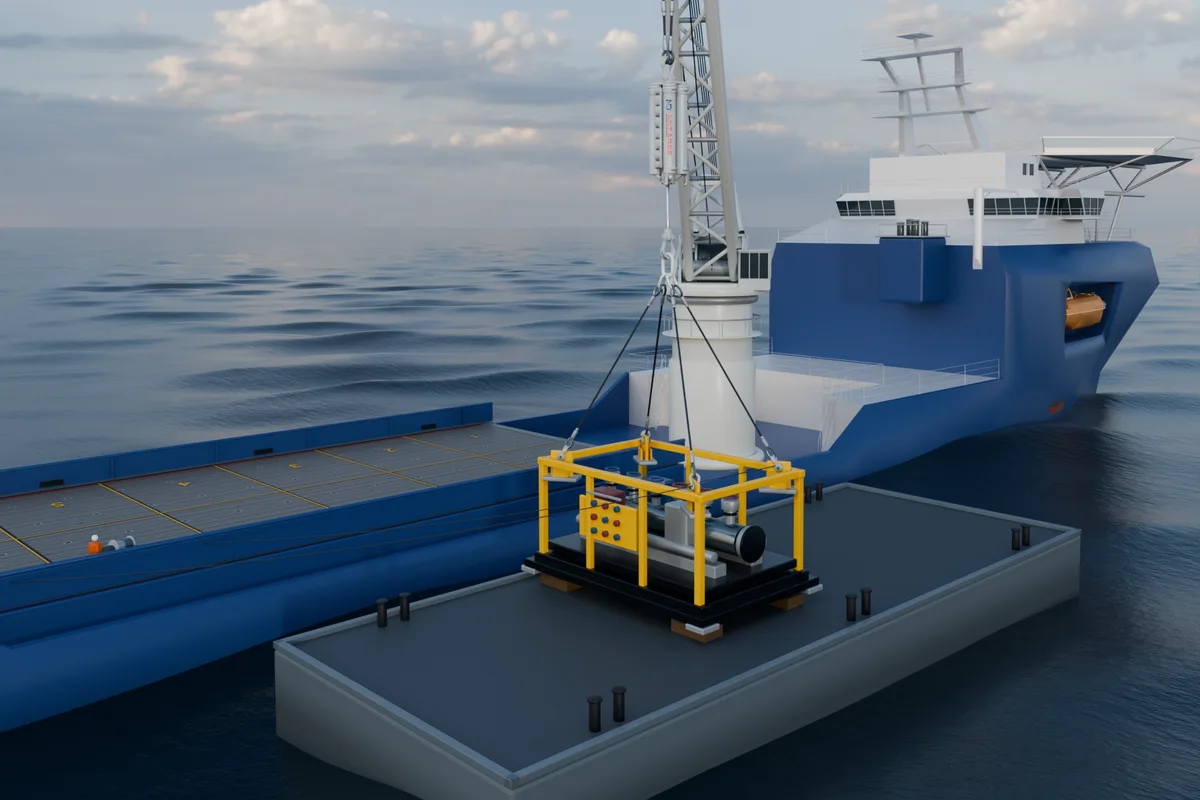
- When a crane lifts a load off a heaving deck, the deck can come back up and strike the load before it is clear: a re-contact. A slow hoist often loses that race.
- In a quick lift, the compensator carries part of the load’s weight while the load still rests on the deck, then retracts fast at the moment the lift procedure defines, and lifts the load clear in one move.
- In our CONSTELLATION case of a 250 t load lifted by the crane alone, the deck struck the load again in every run at 1 to 3 m/min, and in 15 % of runs at 20 m/min. With the ANTARES quick lift it happened in none of the 120 runs at any speed.
- ANTARES has quick lift built in, powered by its own onboard systems. An active unit can do the same with its drive; our VEGA is in development.
A load resting on a barge or supply vessel offshore rises and falls with the deck. When the crane takes it, the deck may be on its way down, leaving the load hanging just above it, and on the next wave the deck comes back up. If the load has not cleared by then, the deck strikes it from below.
The race against the deck
A crane lifting a heavy load hoists slowly, often a few metres per minute. After lift-off the load rises only as fast as the hoist, a few centimetres a second, while the deck drops away and comes back up at up to a metre a second relative to the crane hook. If the deck’s next rise is higher than the load has climbed by then, and in an irregular sea the next crest can be higher than the last, the deck catches it (Figure 1). DNV-RP-N103 treats this as the probability that the barge hits the lifted object after lift-off, set by the hoisting speed against the motion between the crane hook and the deck, and a lift plan has to keep it below a set value.
A faster hoist helps, but a crane that is large enough for the load is rarely fast enough to outrun the deck. The quick lift takes the problem away from the hoist: the compensator lifts the load clear in one fast move, and the crane then hoists it away at its own speed.
How a quick lift works
- Hold. While the load still rests on the deck, the compensator is charged to carry part of its weight. The rigging is tensioned, but the load stays down.
- Follow. The rod is left with travel to follow the deck as it rises and falls under the load, and with travel for the retraction to come.
- Fire. At the planned moment, usually as the deck starts to fall away, the compensator retracts fast.
- Clear. The retraction lifts the load clear in one move, and the crane hoists it away. The lift analysis checks the clearance through the following waves, the peak loads and the stroke used.
The best moment to fire depends on the crane, the load and the deck together; the top of a wave is not always it. The hold is set so that the deck still carries part of the load’s weight at every instant before the fire, including as the deck drops away over a crest and the gas force rises with the stroke, so the load never lifts off by itself.
How the retraction is powered
| Method | How it works |
|---|---|
| Accumulator switch | The cylinder is switched from its low-pressure accumulator to a pre-charged high-pressure one, sized to retract the load in question |
| Gas injection | High-pressure gas is connected to the working accumulator through a large connection, raising the force |
| Active drive | On an active unit, the drive adds the lifting force; VEGA’s drive is battery powered |
The retraction force is set for the lift: too much snatches the load and raises the peak sling load, too little lifts it too slowly, and the retraction has to stay inside the working stroke. Our units have end damping to soften an end-of-stroke contact, but the lift is planned so that it does not happen.
Our 250 t case
In a CONSTELLATION model of a 250 t load lifted off a heaving deck in one irregular sea (Hs 2.16 m, Tp 5.5 s), we ran 120 realisations of that sea at each of four hoist speeds with a conventional crane, and again with the ANTARES quick lift, both started at the same favourable point in the deck’s motion.
In the quick lift the load left the deck at a payload DAF of 1.27, with a peak sling load of 3,118 kN, inside the rigging and crane limits, and used 64 % of the ANTARES stroke. No re-contact in 120 runs gives an exact 95 % confidence interval of 0 to 3 % for the re-contact rate in this model. It is one load and one sea state: every lift is sized on its own load, vessel and sea.
Which units can quick lift
ANTARES has quick lift built in, powered by its onboard systems with no external power, and can fire it multiple times per charge. An active unit can quick lift with its own drive; our VEGA active unit is in development. Our passive units, RIGEL and CYGNUS, are set on deck for the lift and do not retract on command; in line with a crane they soften the snatch at pickup instead (see transfer lifts).
Sources and assumptions
- The 250 t case was modelled in CONSTELLATION as one coupled time-domain load path, in one sea of Hs 2.16 m and Tp 5.5 s with 120 realisations at each hoist speed. A re-contact is any strike of the deck on the load after lift-off, the event DNV-RP-N103 uses for lift-off (Section 9.5.2). The frequencies are counts from the simulated runs, not the RP’s closed-form estimate, which assumes the load leaves at a crest and never exceeds 50 %. The conventional crane and the quick lift use the same load, sea state and favourable trigger condition.
- Crane alone, runs with a re-contact: 100 % at 1 to 3 m/min, 86 % at 5, 52 % at 10 and 15 % at 20 m/min. ANTARES quick lift: 0 of 120 at each speed.
- For zero re-contacts in 120 runs the exact (Clopper-Pearson) binomial 95 % interval is 0 to 3.0 %; the one-sided 95 % upper bound is 2.5 %.
- The case is a model result for one load and one sea state, not a general operating limit.
Frequently asked questions
What is quick lifting?
Lifting a load clear of a moving deck in one fast move. The compensator carries part of the load’s weight while it rests on the deck, then retracts fast at a defined moment, so the load clears before the deck comes back up.
Why is quick lifting needed?
A crane that is large enough for a heavy load hoists slowly, while the deck it lifts from can move at a metre per second. After a slow lift-off, the deck’s next rise can strike the load. A quick lift gets the load clear in one move.
When is the quick lift fired?
At the moment the lift procedure defines, usually as the deck starts to fall away. The best moment depends on the crane, the load and the deck together, so it is set in the lift analysis; the top of a wave is not always it.
How is the retraction powered?
By switching the cylinder to a pre-charged high-pressure accumulator, by injecting high-pressure gas into the working accumulator, or, on an active unit, by its drive. ANTARES does it with its onboard systems, with no external power.
How likely is a re-contact without a quick lift?
In our 250 t model case, with the crane alone hoisting at 1 to 3, 5, 10 and 20 m/min, the deck struck the load again in 100, 86, 52 and 15 % of runs. With the ANTARES quick lift it happened in none of the 120 runs at each speed. That is one model case, in one sea of Hs 2.16 m and Tp 5.5 s, not a general probability.
Which compensators can quick lift?
ANTARES has quick lift built in and can fire it multiple times per charge. An active unit can do it with its drive; our VEGA is in development. A plain passive unit such as RIGEL or CYGNUS, set on deck for the lift, does not retract on command.
Lifting off a moving deck?
Send us:
- the load and its rigging
- the crane and its hoist speed
- the vessel or barge the load sits on, and the sea states
We’ll model the lift-off in CONSTELLATION, with the crane alone and with a quick lift, and give you the clearance, the loads and the stroke it needs.
Send your lift case →