Deck→seabed
One continuous coupled run


CONSTELLATION, our in-house time-domain lift simulator, models your whole operation deck to seabed, then screens it across every sea state to DNV-RP-N103. You get your operating window (Hs×Tp), the governing limit, and what the compensator buys: before anyone mobilises.
CONSTELLATION solves the whole operation from first principles: the payload equation of motion with real-gas gas-spring thermodynamics, Morison hydrodynamics, and the splash-zone and landing dynamic-amplification basis per DNV-RP-N103, on our ND-DS modelling basis. It builds the complete load path (crane, vessel, rigging, compensator and payload) as one coupled time-domain model.
CONSTELLATION is verified code-to-code against OrcaFlex (an independent, industry-standard marine dynamics solver) on identical cases. Not against itself.
| Splash-zone entry | 9 of 9 physics laws verified against the reference solver |
|---|---|
| Resonance passage | Within 0.2 % on all forces and forced-response stroke |
| Pile-run arrest | Crane peak within 0.25 %, stroke within 0.5 % |
| Basis | DNV-RP-N103 · DNV-ST-N001 · ND-DS standards |
Further lifting regimes are added to this list as each one is qualified.
A screening remains an engineering prediction, not a certified analysis, but the physics behind it has been shown to match an independent solver on the cases we publish.
Every sea state, gate by gate. The example below is a representative deck-to-seabed install of a ~190 t subsea structure on the ANTARES 250 t adaptive compensator at head sea.
The workable region reaches Hs 2.5 m at the design period (Tp 8 s), and the ringed cell is the modelled sea state (Hs 2.0 m). Blank cells behind the dashed line are steeper than DNV-RP-C205 allows: such seas do not occur.
Solid: the modelled boundary. Dashed: the DNV-RP-C205 steepness limit. Short, high seas do not occur, so the sea itself caps the short periods; the window narrows again toward the long-period swell.
| Standard | DNV-RP-N103 · ND-DS-10 |
|---|---|
| Payload | ~190 t subsea structure |
| Compensator | ANTARES 250 t adaptive |
| Heading | Head sea |
| Climatology | Representative winter |
| Governing limit | Splash-zone gates in steep seas; stroke toward the swell |
CONSTELLATION results are engineering predictions screened to DNV-RP-N103 and our ND-DS basis on the supplied metocean, not a certified analysis. The operating window is confirmed against project metocean and the contracted vessel before issue.
One continuous run from deck to seabed, not a static check. The compensator switches gas mode per phase as the load goes overboard and submerges.
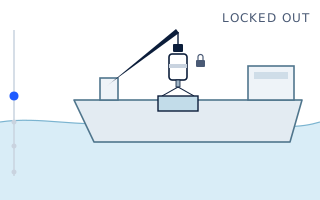 1 · ON DECK
Rigged and lifted off; the compensator is locked out.
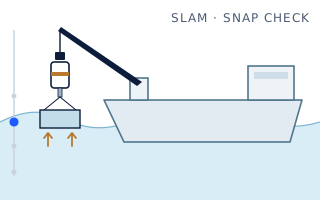 2 · SPLASH ZONE
Overboard through the wave zone: slam and snap load checked.
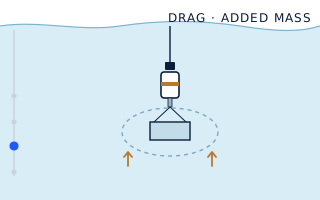 3 · LOWERING
Mid-water descent through the heave-resonance band; drag and added mass build.
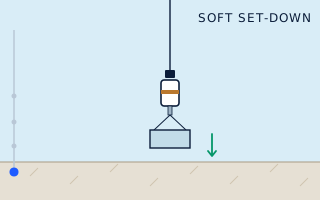 4 · SEABED LANDING
Soft set-down onto the soil reaction.
Each screened sea state must clear every acceptance gate to count as workable.
| Splash-zone crossing DAF | ≤ 2.0DNV-RP-N103 |
|---|---|
| Slack-sling events | = 0DNV-RP-N103 |
| Landing DAF | ≤ 2.5ND-DS-10 |
| Touch-down speed | ≤ 0.5 m/sND-DS-10 |
| Stroke utilisation | ≤ 90 %ND-DS-10 |
Acceptance limits shown are CONSTELLATION screening defaults aligned to DNV-RP-N103 practice and our ND-DS basis, not a project-specific certified limit. For execution we screen against the project’s own DNV basis.
A screening is a counterfactual, not a clip: the same operation is solved with the compensator and without it, against the governing limit. These are the numbers behind the films further down: every value is the simulation’s own result for the stated case.
TLP tendon pretension · one storm realisation, Hs 4.0 m / Tp 12 s · every peak within SWL
Punch-through arrested inside the stroke · rigid-link figure from the matched simulation
Ø6 m caisson, 120 m water · one design sea state, Hs 2.5 m / Tp 8 s · pulled out of the clay
250 t module off a feeder barge, jack-up crane · same sea, Hs 3.5 m / Tp 7.5 s
150 t subsea manifold to 150 m · Hs 3.0 m / Tp 8.0 s · the film runs this case end to end
GRP cover through the wave zone · the criterion the splash gate enforces on every screened cell
Representative cases modelled in CONSTELLATION and screened to DNV-RP-N103 practice and the ND-DS basis: engineering predictions, not certified analyses. The POLARIS rigid-link and CYGNUS bare-wire figures are counterfactual baselines for the same realisation.
Each clip is a CONSTELLATION simulation of a real lift case: the same first-principles, coupled model we run to screen your operation. Watch the compensator hold line tension through the sea state.
Passive heave compensation for a GRP cover lift.
Adaptive passive heave compensation on a subsea lift.
Lifting off a heaving feeder barge: clear first time.
Out of the mud, within SWL: a suction caisson from firm clay.
Every wave, within SWL: a TLP tendon pretension line through a storm window.
Landing it is the easy part: CYGNUS keeps the assembly in contact through settlement, heave and the bolt-up hold.
Through resonance, in control: a flooded suction pile past 1,300 m.
The tension window, the stuck-pipe overpull and the parted-string arrest: hung rigid on the same waves, the string parts fifteen seconds in.
How a lift case becomes an operating window: the method behind the matrix.
Read → KB · PLANNINGWhat a workable window means for vessel time, scheduling and cost.
Read → KB · FUNDAMENTALSWhat DAF means, how it is calculated, and what drives it in offshore lifts.
Read → SWL 55–1,000 t
 SWL 12.5–10,000 t
 SWL 30–4,000 tLift screening
Send us the structure, the vessel and the site, and we’ll model the lift and return the operating window, the governing limit and the recommended compensator setup.
CONSTELLATION results are engineering predictions screened to DNV-RP-N103 and our ND-DS basis on the supplied metocean, not a certified analysis. The operating window is confirmed against project metocean and the contracted vessel before issue.
Find the right compensator →