
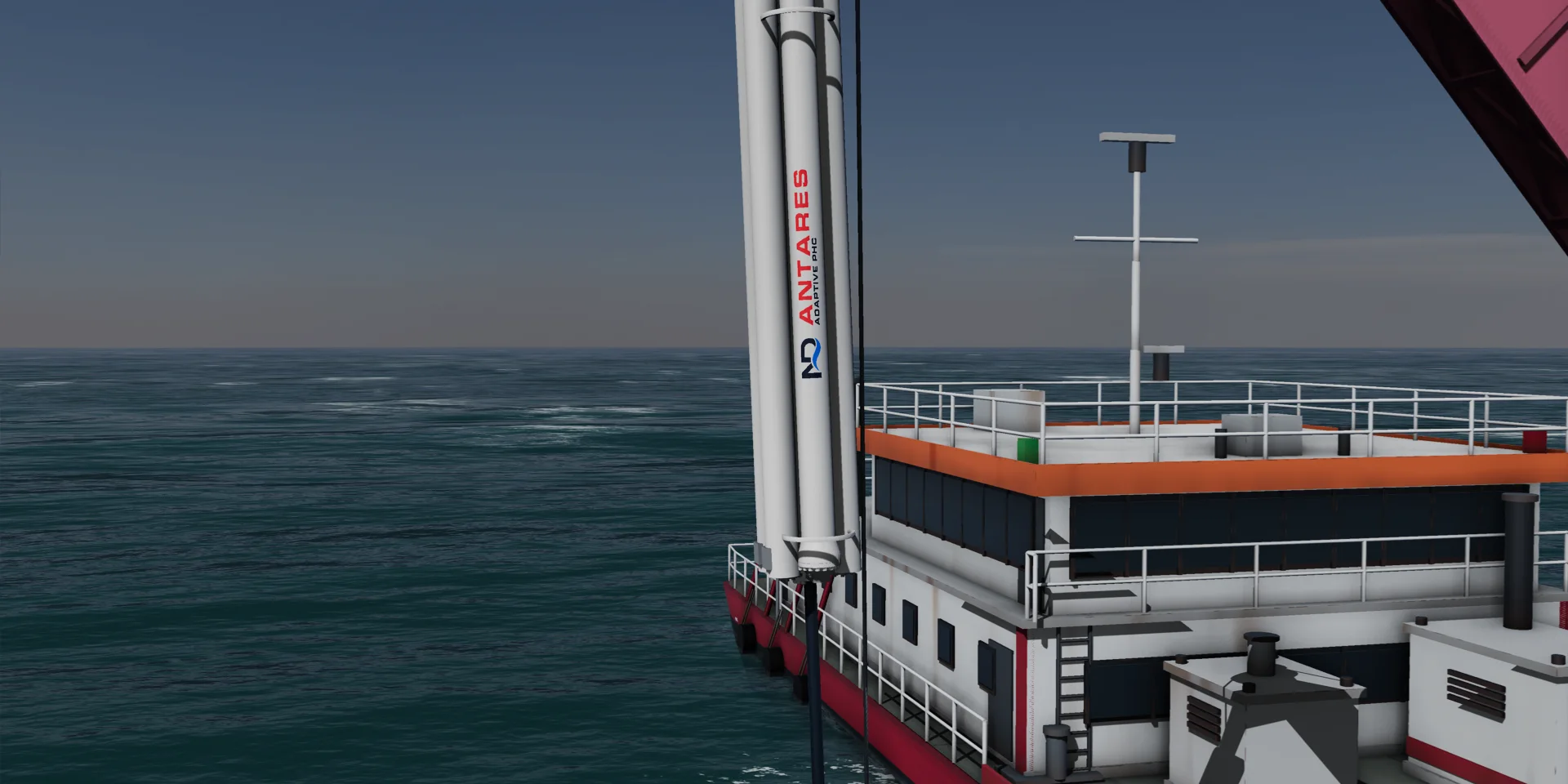
Water injection dredging
A jet beam only works well at the right height above the seabed. A passive heave compensator in the wire takes up the vessel's heave in its stroke, so the beam stays closer to that height.
A jet beam needs a steady height above the bed
In water injection dredging the beam hangs on wires from the vessel's boom and sits close to the seabed. Jets from its nozzles loosen the sediment until it flows away.
The vessel moves with every wave, and the boom head moves with it. If nothing in the wire takes up that motion, the beam rises and falls about as far as the boom head does.
The jetting distance then changes with every wave. Too far from the bed, the jets reach the sediment with less energy. Too close, the beam can land on the bed.
The wire feels it too. When the beam lands on the bed, or the boom head drops faster than the beam can follow, the wire goes slack and comes tight again with a jerk.
What one wave does to the beam
- The wave lifts the vessel and the boom head.
- The wire hauls the beam up by about the same amount.
- The nozzles are further from the bed and the jets work less well.
- The vessel drops, the beam comes down toward the bed, and the wire can go slack and snap tight.
Two places for a compensator in a jet beam rig
The beam hangs on one wire that runs round a sheave block on the beam. That gives two falls. A passive compensator can hang in the wire's dead end under the boom head, or stand on deck with the wire running over a sheave on its rod. The choice is a trade between force and stroke.
Try it with your beam
In-line ranges that cover this pull and stroke: CYGNUS.
Stroke to allow, with the rod using at most 90 % of it: 3.3 m. Ideal values, friction ignored. The drawing is a schematic and not to scale. The vessel's motion sets the travel, and the datasheet for your case sets how far below its rating a unit still works well.
In the dead end
An in-line compensator hangs between the end of the wire and its anchor under the boom head, above the water. It carries the pull in one fall, half the beam's weight. The beam hangs on two falls, so it moves half as far as the rod does.
It is the simplest to fit. One unit is shackled into the dead end, and nothing changes on deck.
On deck, as a sheave unit
A tensioner stands on deck between the winch and the boom, and the wire runs over a sheave on its rod. Both legs of the wire bear on the unit, which adds up to the beam's weight. The rod moves as far as the beam does.
The unit is within reach on deck, it keeps working while the winch hauls, and the boom head carries no extra weight. This is the arrangement we prefer for a jet beam.
| In the dead end | On deck, as a sheave unit | |
|---|---|---|
| Force on the unit | About half the beam's weight, as a pull | About the beam's weight, as a push on the rod |
| Rod travel for 1 m of beam motion | 2 m | 1 m |
| Where it sits | Under the boom head, in the wire | On deck, between the winch and the boom |
| Our unit | CYGNUS, ANTARES or RIGEL | SIRIUS |
| Suits | A quick fit with nothing new on deck, and a boom head with room for the longer stroke | Long campaigns, light beams and tight stroke room |
Both arrangements do the same work, force times stroke. We offer both, and we fit both from our own product families wherever we can.
Which unit fits a jet beam
On deck we fit a SIRIUS tensioner as the sheave unit, and that is our first choice. In the dead end we fit an in-line compensator. A build to order is the fallback for a beam no size covers.

A tensioner that stands on deck with the wire over a sheave on its rod. It holds the tension in the wire while the vessel moves. Its sizes start at 5 t, so it covers light beams, and it is quoted to your case.
- Design targets
- 5 to 5,000 t
- Stroke
- 1.0 to 12.0 m
- Damping
- manual
- Place
- on deck

Our default in-line unit, the lowest in cost and the lightest. EQ control returns it to mid-stroke as load and geometry change.
- Design range
- 12.5 to 10,000 t
- Stroke
- 1.0 to 6.0 m
- Damping
- manual
- Power
- small battery, no umbilical

Automatic damping control and strokes to 8.0 m. The long stroke helps in the dead end, where the rod travels twice as far as the beam. It is more unit than most jet beams need.
- Design range
- 30 to 4,000 t
- Stroke
- 2.5 to 8.0 m
- Damping
- automatic
- Power
- battery, no umbilical

The most compact in-line unit and the easiest to handle, with no electronics offshore. Its range starts at 55 t, so it suits the heavier beams.
- Design range
- 55 to 1,000 t
- Stroke
- 1.0 to 6.0 m
- Damping
- manual, set on deck
- Power
- none
How a light beam lands in our ranges
On deck the unit carries the beam's whole weight. In the dead end it carries half. So the place also decides how hard a beam loads the unit. A unit can work below its rating. In the example below a 30 t unit carries about 6 t in the dead end and passes every check.
| Unit | Smallest size | Where it goes | Beam weight at which the load equals that size |
|---|---|---|---|
| SIRIUS | 5 t | On deck, as a sheave unit | about 5 t |
| CYGNUS | 12.5 t | In the dead end | about 25 t |
| ANTARES | 30 t | In the dead end | about 60 t |
| RIGEL | 55 t | In the dead end | about 110 t |
Ideal values, friction ignored. SIRIUS figures are design targets. How far below its size a unit works well is set for your case, with capacity and stroke.
A 15 t beam in 1.5 m waves, on a rigid wire and with the unit
CONSTELLATION ran the same rig through the same eight seas three ways: on a rigid wire, with an ANTARES 30 t in the dead end, and with the same gas spring and stroke working as a sheave unit. Each run is ten minutes of dredging.
Height over the bed
rigid wire dead end sheave unit
The shaded band is the jetting window, 0.25 to 2 m. The rigid wire leaves it at both ends.
Tension in one fall
rigid wire dead end
When the beam lands on the bed the rigid wire goes slack, then snaps tight. With the unit the tension stays between 47 and 68 kN in every sea.
Stroke the unit uses
dead end sheave unit
In the dead end the rod travels twice as far as the beam and uses up to 90 % of its 6 m. As a sheave unit it uses up to 75 %.
Forty seconds of one sea on each chart. The film above is the last 22 of them. The figures in the boxes are the worst of all eight seas.
Where the unit stops helping
In 1.8 m waves the dead-end unit runs out of stroke in six of the eight seas, and in the worst one the beam touches the bed once. The same unit as a sheave unit still keeps the beam off the bed in every sea, because its rod only travels as far as the beam.
That is the trade the sizer above shows. A longer stroke or the other place moves the limit, and we tell you which sea state it sits at for your rig.
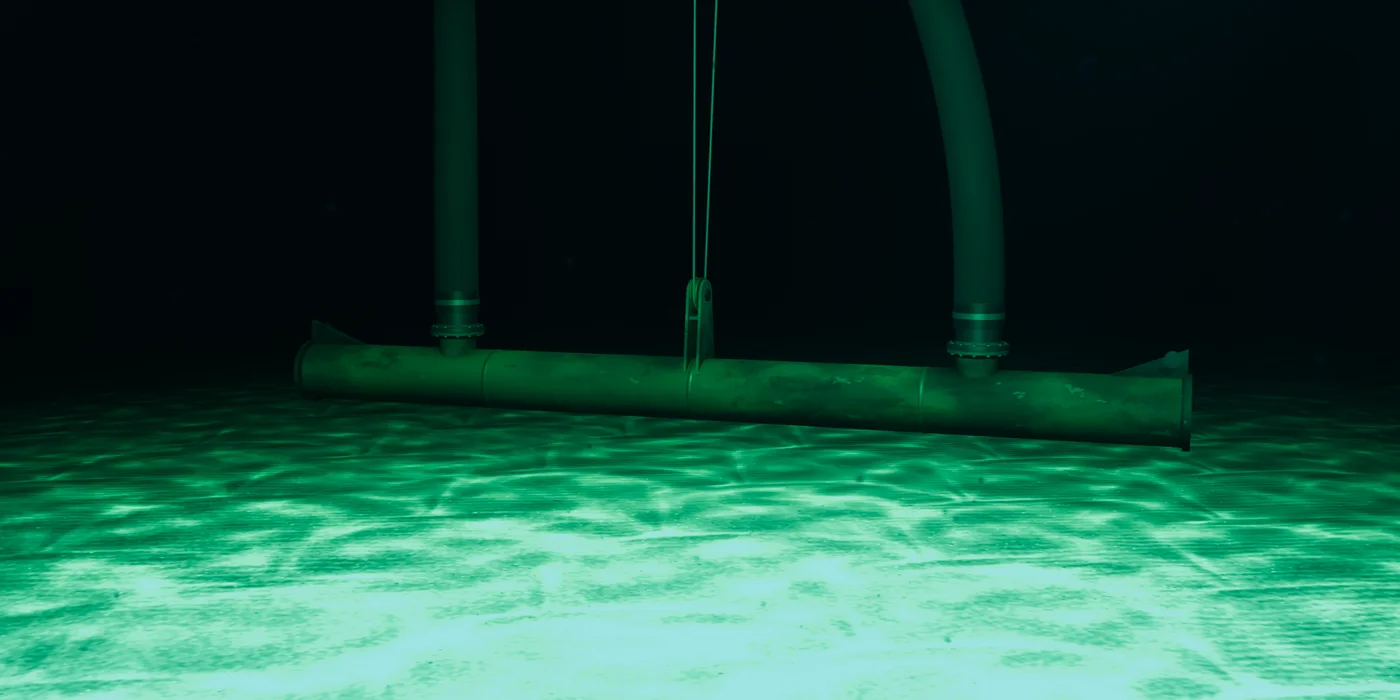
| Vessel | A 40 m class workboat in head seas, with a 16 m boom over the side, its head 15 m above the water |
|---|---|
| Beam | 12 m long, 15 t in air and 13.0 t in water, 100 nozzles fed with 5,400 m³ an hour |
| Wire | One 32 mm wire on two falls, 58 kN in each fall with the jets running |
| Site | 15 m of water over soft clay, the beam working 1.0 m over the bed |
| Sea | Hs 1.5 m, Tp 7 s, eight wave realisations, ten minutes graded in each |
| Unit | ANTARES 30 t with 6 m stroke, in the dead end and as a sheave unit. It is the unit the example ships with. For this beam we would offer a smaller one, and a SIRIUS on deck first. |
| Basis | CONSTELLATION 1.8.197, its own dredging example. An engineering prediction for this rig and sea, not a certified analysis. The model leaves out wave motion in the water at the beam, any cushion from the jets near the bed, and sheave friction. |
What we need to check your beam
Rough values are enough to start. We run the rig in CONSTELLATION through your sea states, with a rigid wire and with the unit, and come back with a unit, its place on the wire and what it does to the beam.
You get the sea state where the beam stays inside your height band, the range of wire tension, and the share of the stroke the unit uses. When the unit runs out of stroke first, we say so and try the other place or a longer stroke. A screening is an engineering prediction and not a certified analysis.
- Beam weightin air and in water
- Reevingnumber of falls
- Boom headposition and height
- Water depthrange you work in
- Working heightband above the bed
- Pump flowfor the jet reaction
- Sea statesHs and Tp, and heading
- Vessellength, beam and draught
What dredging crews ask about a compensator
A dead-end unit carries half the beam and strokes twice as far
The beam hangs on two falls, so the pull in the dead end is half the beam’s weight, friction ignored. The rod moves twice as far as the beam does, so 1 m of beam motion calls for 2 m of rod travel. A sheave unit on deck turns this round, with the full force and the same travel as the beam. Which one fits depends on the force and the stroke your rig can take.
A light beam is easier to cover on deck
On deck the unit carries the beam’s whole weight, and the SIRIUS sizes start at 5 t. In the dead end the unit carries half the beam, and our in-line ranges start at 12.5 t. A unit can work below its rating, and we check how far for your case.
The compensator takes up the heave without power from the vessel
Compensation is passive, a gas spring and hydraulic damping. SIRIUS and RIGEL have manually set damping. CYGNUS carries a small battery and ANTARES a battery for its control system. Neither needs an umbilical.
A compensator reduces the beam’s motion and has limits
It cannot hold the beam still in every sea. If the vessel moves more than the stroke allows, the rod reaches its end. CONSTELLATION shows the sea state where that happens, so you know before you mobilise.
Beam weight, number of falls and the sea states are enough to start sizing
Capacity follows the force on the unit, which comes from the beam’s weight and where the unit sits. Stroke follows the vessel motion and the working height you need. Send the beam weight, the number of falls and the expected Hs and Tp, and add the rest as you have it.
Tell us about your beam
Send the beam weight, the number of falls, the water depth and the sea states you work in. A sketch is enough to start. We start from the standard range.
post@nodynamics.com
+47 9664 7886
Designed to DNV-ST-0378. A DNV product certificate is optional.